
Brand Management Maturity Model + AI Readiness

Introduction
Managing a brand well means coordinating work across content distribution, marketing automation, social media, and customer relationships. A digital asset management system (DAM), such as Acquia DAM, sits at the center of that work, as the place where content is created, organized, published, and measured.
To help organizations get more from that investment, Acquia built the Brand Management Maturity Model, a benchmarking tool that assesses brand management practices across six interconnected dimensions: strategy, people, process, technology, AI readiness, and impact.
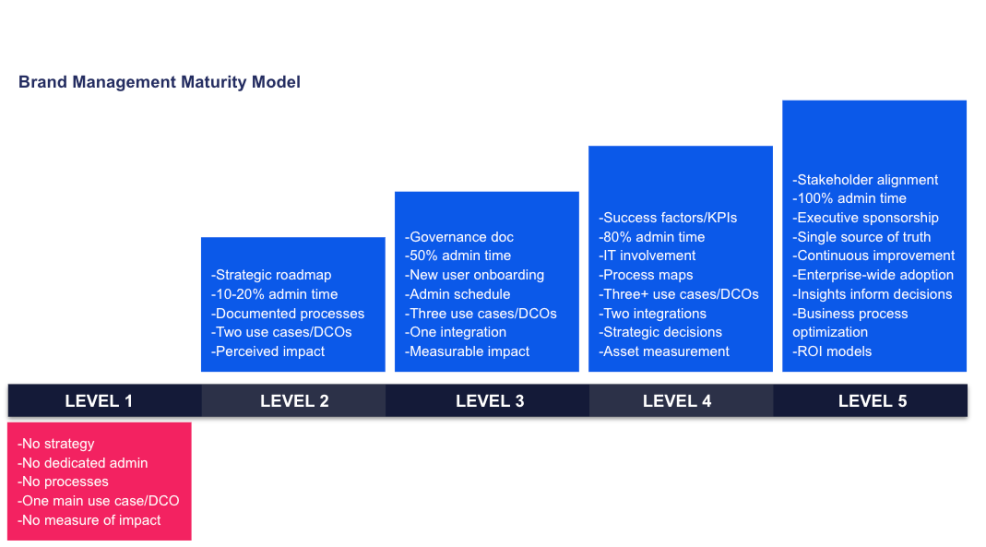
Note: DCOs refer to what we call “desired customer outcomes.”
What is new in this version. AI readiness is a new sixth dimension, added in 2026. The four practice dimensions have also been updated to reflect what AI has changed about each one. If you have used this model before, the levels and the structure will be familiar. The new dimension is the part worth your attention.
Why is brand management maturity worth benchmarking?
Organizations adopt DAM to organize brand assets for market expansion, product launches, and customer experience work. How mature those practices are directly affects speed to market and how efficiently the business grows.
Assessing yourself on a regular schedule shows how your practice has changed and sets goals for what comes next. It supports:
- Better customer experiences
- Revenue growth
- Product and service development
- Faster time to market
- Expansion into new markets
There is a second benefit that is easy to overlook. A maturity model gives a team shared language. When a group of people can say out loud where they actually are, the conversation about what to do next becomes much clearer and shorter.
The six dimensions of brand management maturity
The model uses five maturity levels:
- Level 1, Ad hoc
- Level 2, Allocated
- Level 3, Dedicated
- Level 4, Strategic
- Level 5, Distinguished
Assessment covers six dimensions: strategy, people, process, technology, AI readiness, and impact. You can assess each one on its own. Taken together, they describe how capable your brand management practice is.
Most organizations are not at the same level across all six, and that is normal. It is common to be strong on technology and weaker on AI readiness, because they measure different things.
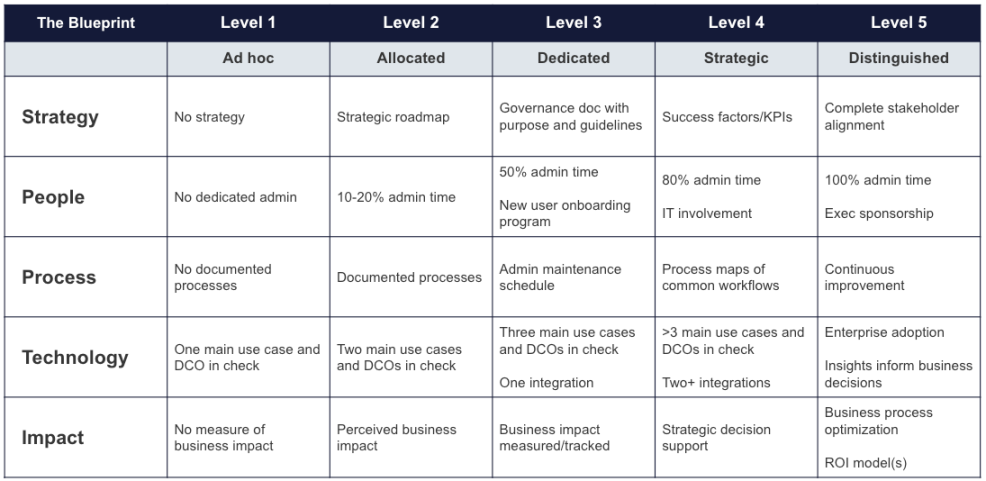
The first dimension: strategy
A clear strategic roadmap underpins brand management success. Strategy connects your DAM practice to what the organization is trying to do, and it drives improvement in every other dimension.
Start with a workshop to generate ideas, set goals, and define key performance indicators. One indicator worth tracking early is consistent DAM use across teams. Write a governance planning document that defines how the system should be used. That document is what makes alignment possible later.
Once governance exists, share the results with internal and external stakeholders, put the strategy into practice broadly, review how it went, and adjust.
At the highest level, a strategy now also anticipates AI-era brand needs. That means planning for how AI tools and AI-driven search will find and represent your brand, not only for how your own teams will use your content.
The second dimension: people
Staffing matters because digital asset management is where brand management actually happens day to day.
Organizations build staff maturity through coaching from a qualified DAM vendor. If a small team shares administrator duties, divide the workload or set a rotation. Build a coalition of stakeholders to drive engagement and surface opportunities. Work with HR to add DAM training to new employee onboarding. Encourage administrators to join an external user community, where they can compare notes with peers.
Administrator time is the clearest signal of maturity in this dimension. It moves from no dedicated administrator at all, to 10% or 20% of one person's time, to half, to most of a role, to a fully dedicated one with executive sponsorship behind it.
Two things have changed here. At the lower levels, AI-assisted tagging and enrichment now absorb work that used to be manual, which means an administrator with 20% of their time can cover more ground than before. At the higher levels, the role shifts. A mature administrator directs AI tools to carry out governance work rather than doing all of it by hand, and AI literacy becomes a core competency for the team rather than a personal interest.
The third dimension: process
Formal, documented processes improve brand management considerably, but many organizations skip this discipline entirely.
If you are early in this work, start by treating the DAM as your central source of truth, rather than keeping parallel libraries and shared drives alongside it. Map your common workflows and find the roadblocks by asking every team that touches the system. Build a way for users to send you suggestions continuously. Audit your content and usage on a regular schedule.
As your practice matures, run regular training on system updates, write a DAM success roadmap, set metrics you can support with data, and tell the company when something improves.
A mature AI policy for DAM is short: one page answering three questions – what AI does in our workflow, where a person reviews before publishing, and what happens when AI gets something wrong. By Level 3, you should write this policy down. By Level 4, your process maps should show which steps AI handles, which need human review, and how errors get escalated.
The fourth dimension: technology
Brands work efficiently when they use the technology they own consistently and to its full capacity. Most organizations use a fraction of what their DAM can do.
You get more from the investment by building curated portals for personalized content delivery and using embed codes to deploy assets across the web. More advanced organizations roll DAM capabilities out across the enterprise and use analytics to inform decisions.
Mapping how your DAM connects to the rest of your stack is worth the afternoon it takes. Chart the connections to your content management system, work management platform, product information management, enterprise resource planning, product lifecycle management, ad networks, web content management, and email service provider. Those integrations make the DAM the central source of truth in practice, not just in theory.
This is the dimension AI has changed most. Auto-tagging is no longer a mark of sophistication. It is the baseline, and activating it is what moves an organization off Level 1. By Level 3, the full enrichment set should be working: AI tags, alt text generation, facial recognition, and video transcription. By Level 4, natural language search is active, so people can find assets by describing what they mean rather than guessing at keywords. At Level 5, generative and agentic workflows are running in production, and analytics inform content decisions rather than only reporting on them.
The fifth dimension: AI readiness
This dimension is new, and it asks a different question from the others.
The first four dimensions all ask some version of the same thing: can your people find, use, govern, and measure brand content. AI readiness asks whether a machine can trust it.
That distinction matters more than it sounds, because AI systems are reading your brand content whether or not you have adopted AI yourself. Your website, PDFs, product descriptions, and press releases are being used to answer questions about you right now. An AI system will not pause when two sources disagree, and it will not check whether the file it found is the current version.
This isn’t just a hypothetical risk: 27% of marketers say their brand has already been described inaccurately in an AI-generated response, yet only 24% of organizations have a formal process for monitoring what AI systems say about them. Exposure to AI starts before adoption does, which is why this dimension starts at Level 1 for everyone.
Here is what each level looks like, written the way a practitioner would describe it.
Level 1, Ad hoc. AI is not part of our DAM thinking. Content is hard to find even for humans. There is no governance for how AI tools may use or misrepresent our brand assets.
Level 2, Allocated. Teams are experimenting with AI outside the DAM, finding it helpful but ungoverned. We have not yet defined what "good" looks like for AI and our content.
Level 3, Dedicated. We have made our content findable and trustworthy. Teams follow a documented policy for how AI tools interact with brand content. We know the risks and actively manage them.
Level 4, Strategic. The DAM is the starting point for every AI-assisted workflow. Humans review AI outputs before anything reaches a customer. Our content governance gives us confidence rather than anxiety about AI adoption.
Level 5, Distinguished. AI works alongside our team at scale, with the DAM as the trusted foundation. Governance is built into the workflow, not bolted on. Our brand shows up consistently whether a human or an agent is doing the work.
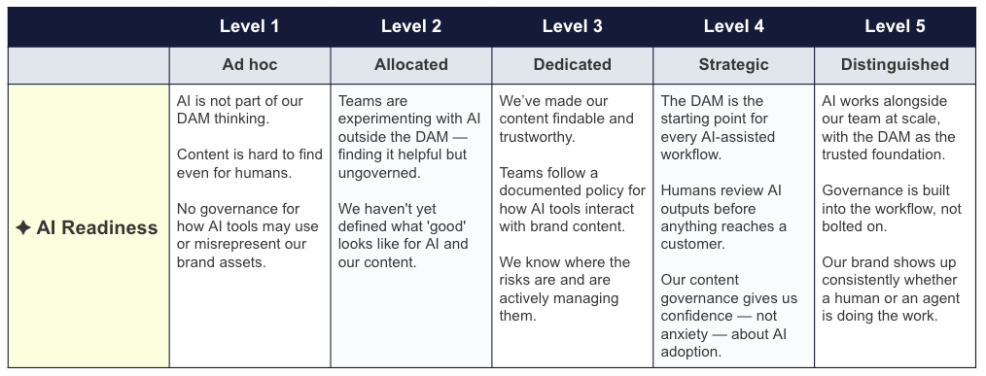
One honest caveat. AI readiness is the only dimension in this model whose score is set partly by systems outside your organization. You can do everything right internally and still not know what an external AI system is saying about your brand today. Treat your score here as a starting point for a conversation rather than a precise measurement.
The sixth dimension: impact
Organizations early in their maturity do not know what their DAM is doing for the business. They may believe it helps. They have not measured it.
Measuring and reporting impact turns a DAM from a tool into a business case. Mature organizations use that data to guide brand decisions and to justify continued investment.
How often an asset appears in an AI-generated answer is becoming as relevant a measure of impact as how often a page was viewed. At the highest level of maturity, insight dashboards now track content performance across both AI and non-AI channels.
How to improve your AI readiness score
Each step below assumes you have completed the one before it.
Level 1 to Level 2: get the foundations right
Start a conversation with your team about where AI is already touching your brand content, even informally. Think things like generated copy, AI images, and automated social posts. Name it before you try to govern it.
Then establish one principle: approved assets live in the DAM. If your team cannot find what they need there, they will create or generate something else. Findability is the foundation of everything that follows.
Set one expectation. Review and approve AI-assisted content before it enters the DAM as a final asset.
Level 2 to Level 3: define what good looks like
Define what "trusted content" means for your organization. What makes an asset brand-safe, rights-cleared, and accurate enough to be the source an AI tool draws from?
Find your highest-risk ungoverned workflows. Where are teams bypassing the DAM to move faster? Bring those workflows in rather than blocking them out, because blocking them tends to push them further out of sight.
Write your AI governance policy for the DAM. One page is enough.
Run a metadata health check. If your best assets are not findable by your own team, they will not be findable by an AI system either.
Level 3 to Level 4: build workflows people trust
Change the question from "are we using AI?" to "how does AI make our team faster and our brand safer?" Measure both.
Build your first workflow with a person in the loop. Map where AI assists by generating, suggesting, or tagging; where a person approves; and where content moves from draft to brand-approved.
Use your DAM content analytics tools to understand which assets actually perform. That data becomes the feedback loop that improves AI content decisions over time.
Connect the DAM to the tools your teams already use. Every integration strengthens its role as the source of truth and reduces the chance of an AI tool pulling from an ungoverned source.
Level 4 to Level 5: make governance part of the workflow
Establish a cross-functional AI governance group. Bring marketing, IT, legal, and brand together to agree on what AI may do on its own, what needs human review, and what needs explicit sign-off.
Treat your taxonomy and governance documentation as infrastructure rather than administration. The AI tools of the next few years will rely on the structures you build now.
Pilot an agentic workflow in a controlled environment, even a simple one. Governance gaps surface quickly when a system is acting rather than only assisting.
Then ask the question that tells you where to go next. If an AI system represented our brand in a customer conversation today, would it be accurate, on-brand, and compliant?
Sample steps to improve brand management maturity
Substantial progress is possible within 12 months. A practical sequence:
- Write a governance document that outlines your purpose and guidelines.
- Set aside eight hours a week for DAM maintenance and user engagement, through a dedicated administrator or a team that shares the work.
- Document how you upload and tag new assets as part of your creative workflow.
- Map your marketing technology stack to identify the role DAM plays across the content lifecycle in data management, creative workflow, and content operations.
- Identify two or three key performance indicators for content use and two or three for platform use, then report on them monthly, quarterly, and annually.
- Score yourself on AI readiness and pick the single next step from the section above.
Putting it all together
Brand management maturity matters because it helps organizations achieve the outcomes that led them to adopt a DAM in the first place. The model is flexible, so prioritize the dimensions that matter most to your situation.
One closing thought on how to use it. Level 5 is not the goal for most organizations, and any maturity model that suggests otherwise is selling something. A team at Level 3 with findable content, a written policy for how AI tools touch brand material, and an honest view of where the risks sit is in good shape. The value is not the score. It is that a room of people can now say where they are and agree on what comes next.
Next steps: Watch the on-demand webinar to see the model applied to a real practice, or request a demo of Acquia DAM.
This article was originally published on Widen.com.

Vice President, Sales and Go-To-Market, DAM and PIM Acquia


