


Web Technologist, Drupal Builder & Open Source Advocate Acquia
Collection
Drupal at the Turning Point: Analyzing the Arrival of AI, Composable, and Orchestration Futures
Collection :
Executive Summary: The DrupalCon Mandate
The final quarter of 2025 marks a definitive strategic inflection point for the Drupal project. The recent DrupalCon Vienna in October 2025 was not a standard conference but a "true turning point". It served as the platform for a new strategic mandate, articulated by project founder Dries Buytaert: rather than treating artificial intelligence as a disruptive threat to the open web, Drupal is "running toward the storm," positioning AI as the "way through the storm".
This analysis indicates that Drupal's strategy heading into 2026 is built on three interconnected pillars of innovation. These pillars, which form the structure of this report, represent the most significant developments for agencies, developers, and enterprise users.
- The Visual Composition Revolution: The out-of-the-box experience is being fundamentally transformed by the production-readiness of Drupal Canvas 1.0 and the launch of the new Site Template Marketplace.
- The New AI Offensive: The Drupal AI Initiative has matured from a vision to a production-ready reality, marked by a $1 million funding milestone and the launch of tangible, new AI products like the Canvas AI Assistant.
- The "DXP 2.0" Framework: A new strategic vision has emerged for Drupal as a central orchestration hub. This framework connects internal no-code workflows (ECA) with the wider enterprise stack via the new stable Orchestration module.
This article focuses exclusively on these new and emerging developments, providing a detailed analysis of the innovations defining Drupal at this time and the strategic roadmap for the first half of 2026.
The New Era of Visual Composition
The most immediate and transformative shift in Drupal is the official, production-ready launch of its visual site-building tools. This marks a fundamental change in the platform's core user experience, moving it decisively into the no-code/low-code arena.
Analysis: Drupal Canvas 1.0
The official 1.0 stable release of Drupal Canvas (formerly known as Experience Builder) is slated for November 2025. This release signifies its transition from an experimental initiative to a fully supported, production-ready tool for visual site building. Canvas is built on two core concepts that work in tandem:
- Content Templates: This feature provides an intuitive, visual method for controlling content type layouts directly within the administrative UI. This effectively replaces the traditional, forms-based Manage Display tab with a modern, drag-and-drop interface for non-technical users.
- Single Directory Components (SDC): A Drupal core feature that streamlines frontend development by grouping all related assets—Twig templates, CSS, JavaScript, and metadata—into one folder. This encapsulation ensures components are self-contained, reusable, and easier to maintain, significantly improving the theming workflow and developer experience.
Drupal Canvas 1.0 provides the long-missing bridge between this clean, backend component-driven development and the frontend visual site-building experience. Developers can now build and package discrete functionalities as SDCs (e.g., an author bio card or product feature box).
Canvas 1.0 then discovers these SDCs and presents them to a non-technical site builder as code components that can be dragged directly onto a page. This unified workflow finally solves a major historical pain point for Drupal, connecting developer best practices with end-user empowerment.
The Site Template Marketplace
Announced at DrupalCon Vienna, the new Site Template Marketplace is the commercial and strategic evolution of the Recipes initiative. While Recipes (which became a stable API in Drupal 10.3) allow for the packaging of features (e.g., install a blog and its dependencies), Site Templates package entire websites, including a complete design, layouts, visual styling, and sample content.
This strategic initiative, formally approved and funded by the Drupal Association Board's Vision Fund, is now a reality and we will have an early MVP by DrupalCon Chicago in March 2026. This marketplace is explicitly designed to host both open-source and commercial templates. The roadmap also includes plans to allow users to export their own sites as new templates to share or sell.
The inclusion of commercial templates on an official, curated Drupal.org marketplace represents a profound economic and cultural shift for the ecosystem. Historically, Drupal agencies have operated on a "services" model, charging for custom build hours. This new marketplace creates a "product" model, akin to an app store.
An agency can now explore expanded options, perhaps building one high-quality, polished template and selling it multiple times, generating scalable, high-margin revenue. This provides a powerful financial incentive that directly supports the Drupal Association's goal to "double the number of organizations that are makers". The Site Template Marketplace is not just a feature; it is a new economic engine designed to solve Drupal's "barrier to entry" problem by weaponizing the talent of its own agency ecosystem.
The AI Offensive: Beyond Initial Integration
While the initial launch of the Drupal AI Initiative in mid-2025 was about vision and team-building, the fourth quarter has been about validation, funding, and the delivery of new, tangible AI products.
Strategic Maturation: The $1M Initiative and AI Agents 1.2.0
The most significant strategic update is the success of the Drupal AI Initiative's fundraising campaign. At DrupalCon Vienna, it was announced that the initiative had met its ambitious $1 million goal in just five months (June-October 2025). Described as by far the single greatest fundraising effort ever seen in the history of Drupal, this milestone was achieved through a combination of $200,000 in cash and $800,000 in committed full-time-equivalent (FTE) hours from 22 agency partners.
This market validation is paired with a critical technical milestone: the stable 1.2.0 release of the Drupal AI and AI Agents modules in October 2025. This release stabilizes the API and provider structure, marking the framework as production-ready and paving the way for the 2.0 roadmap. In Q4 2025, the AI initiative decisively transitioned from a "what if" promise to a "how much" ($1M) and "what's next" (1.2.0 stable) reality.
Landmark Innovation: The Drupal Canvas AI Assistant
The flagship AI feature demonstrated at DrupalCon Vienna is the new Drupal Canvas AI Assistant. Now available as the canvas_ai or xb_ai_assistant submodule, this tool enables prompt-based page building with SDCs and has the power to generate code components (but not backend Twig components).
The mechanism is a synthesis of Drupal's two largest strategic bets. A site builder can use natural language prompts, such as, "Create a section showing three key features of my product". The AI Assistant, which requires an AI provider, uses a page builder agent to analyze the prompt. It then scans the site's library of available Single Directory Components (SDCs) and intelligently selects, assembles, and places them onto the Canvas to build the requested layout.
The accuracy of this powerful tool is entirely dependent on a new development best practice. The AI's ability to select the correct component is based on developers providing meaningful descriptions for SDC components and their slots in the component's yml file. This creates a critical AI-first development workflow. A component's description is no longer just documentation; it is functional metadata that the AI Assistant consumes.
The Driesnote Vision: Autonomous Agents and Context Control
The DrupalCon keynote also provided the first concrete demonstration of two next-generation AI capabilities:
- The Context Control Center: A new, centralized UI where teams can define and store core brand truths. This includes brand voice, target audiences, and key data like product prices, company statistics, or official messaging.
- Autonomous Agents: These are AI agents designed to work in the background, autonomously.
This workflow, demoed in the keynote, connects these two features. A marketer updates a key statistic (e.g., a product capability) in the Context Control Center. An autonomous agent then automatically finds every instance of that old statistic across the entire site and proposes updates, which can be reviewed and approved by a human.
This is a profound strategic shift. The Context Control Center provides the canonical single source of truth that makes autonomous maintenance possible. The AI is no longer just a generative tool for creating new content but a governance tool for maintaining existing content. This moves the AI's value proposition from helping marketers write to ensuring brand consistency and data accuracy site-wide, a far more compelling enterprise use case.
New AI Tools for Developers and Site Builders
The AI ecosystem is also expanding through a sophisticated, two-pronged strategy of community and partner modules.
- AI Generation Module (Experimental): A new developer-focused module is being created to allow developers to generate fully functional SDC components (Twig, CSS, and JS) directly from images (e.g., a design mockup) and text prompts. This tool is planned explicitly for accelerating local development and directly addresses the Figma-to-Drupal workflow by automating the creation of SDCs.
- amazee.ai AI Provider (Partner Module): A significant new partner module provides a seamless, enterprise-grade on-ramp to AI. It connects to powerful LLMs with your Drupal applications. It emphasizes enterprise-ready features like data sovereignty (GDPR, SOC2, ISO 27001 compliance) and zero vendor lock-in. Drupal.org is now using this provider to offer free 7-day hosted AI demos, lowering the barrier to entry for the entire community.
These two modules reveal a mature strategy. The Drupal AI Initiative builds the framework (AI Agents), while empowering the community to build velocity tools (AI Generation) and partners to provide the secure, enterprise-ready engine.
Forward-Looking Unified Experiences
Other key transformative shifts in the Drupal landscape are the powerful concepts of orchestration workflows both within and external to Drupal, as well as Gitlab platform modernization and the developer experience.
The DXP 2.0 Vision: Drupal as an Orchestration Hub
Further, the Driesnote introduced a new strategic vision for orchestration, calling it DXP 2.0. This vision repositions Drupal as a central hub for business logic, not just a content repository. This strategy is comprised of two key parts:
- Internal Orchestration: This is powered by the existing, no-code ECA (Event-Condition-Action) module, which allows users to build complex workflows within Drupal. The Driesnote announced that ECA is set to receive a major UX overhaul to make it more user-friendly and accessible to a wider audience.
- External Orchestration: This is enabled by the brand-new Orchestration module, which was released with a stable 1.0.0 version in October 2025. This module is being worked on to act as a bridge to external automation platforms like Activepieces.
This new stack enables powerful, bi-directional workflows. A Drupal event (e.g., a Webform submission) can trigger an Activepieces workflow that updates a CRM, adds a user to a spreadsheet, and sends a Slack message. Conversely, an external event (e.g., a lead status change in a CRM) can trigger the Orchestration module to call a Drupal AI Agent to generate a new, personalized landing page for that specific lead.
This DXP 2.0 vision positions Drupal as the central orchestration brain for a composable enterprise, allowing agencies to sell high-value business process automation, not just websites.
Platform Modernization: GitLab and Developer Experience (DX)
These ambitious initiatives are supported by a critical, long-term investment in Drupal.org's own infrastructure. In October 2025, the Drupal Association announced it had received a €201,000 grant from the Sovereign Tech Fund.
This funding is targeted at modernizing Drupal.org's GitLab infrastructure to improve the Developer Experience (DX). The key goals are to complete the migration of Drupal's security issue management system to GitLab, optimize CI/CD testing, and implement new tools for UX and design contributors. The opt-in phase for migrating project issue tracking from Drupal.org's legacy system to GitLab is already underway as of November 2025.
For years, Drupal.org's bespoke patch system has been a significant barrier to entry for new developers accustomed to modern GitHub/GitLab merge request workflows. This GitLab migration is one of the most important long-term strategic innovations, as it directly lowers contributor friction. It makes it easier to attract and retain the next generation of developers needed to build the ambitious AI and Canvas roadmaps.
This is happening alongside other key DX improvements in recent Drupal 11 releases, including:
- Object-oriented hooks (replacing procedural hooks with modern PHP attributes).
- A new standardized Icon Management API.
- A decoupled Workspaces UI module.
- Stable, security-covered releases of Project Browser.
- Stable Automatic Updates for patch releases and other continued improvements.
The Roadmap and the Path to Drupal 12
The strategic initiatives of 2025 will be solidified by a series of critical product launches and deadlines in 2026.
The Milestone: Drupal CMS 2.0
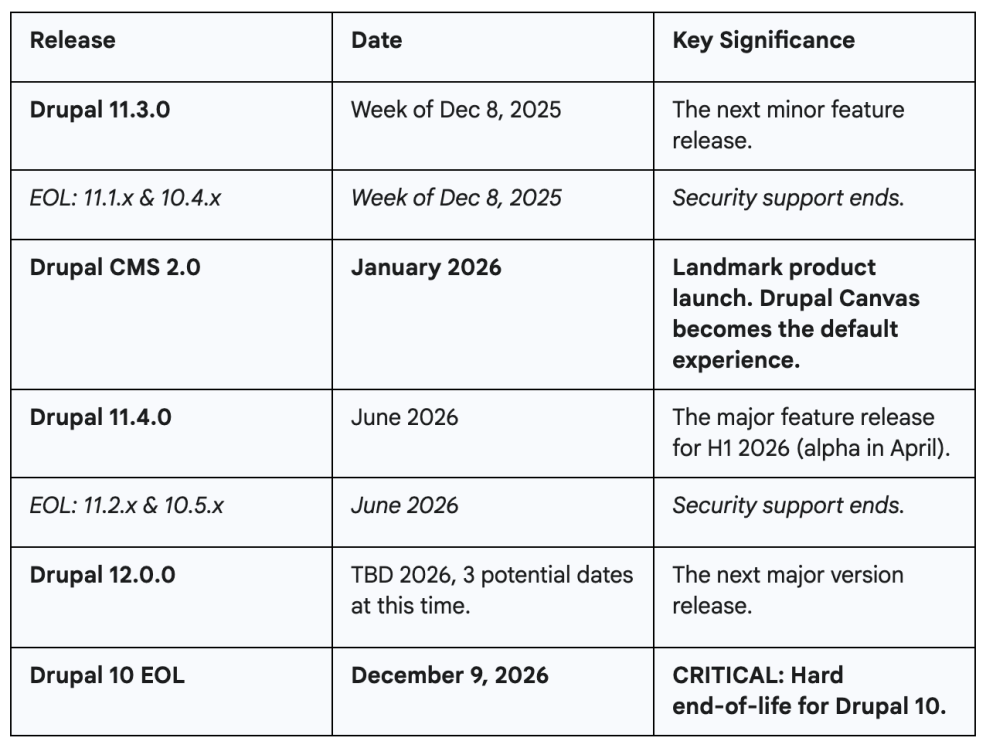
The most significant event of H1 2026 will be the launch of Drupal CMS 2.0 in early 2026. This release is defined by one monumental change: Drupal Canvas 1.0 will become the default page-building experience for all new Drupal installations.
This change cannot be overstated. For years, a new user's first experience with Drupal has been the "node/add" form—a "fields-and-forms" backend interface. In a market defined by the visual, in-place editors of competitors, this has been Drupal's single greatest barrier to entry. As of 2026, a new user's first five minutes with Drupal will be a modern, intuitive, visual, no-code page builder. This is the culmination of the entire Canvas initiative and a strategic repositioning of the entire platform.
It’s worth noting, that a new template, Byte, which was built by Mediacurrent and utilizes the new Mercury theme is shipped in Drupal CMS 2.0. This template allows a user to go from a fresh Drupal installation to a complete, production-ready B2B SaaS site in under three minutes.
Core Release Cadence: 2025-2026
The technical roadmap for H1 2026 is stable, and it leads to a critical, non-negotiable deadline at the end of the year.
- Q4 2025: Drupal 11.3.0 is scheduled for release the week of December 8, 2025. This release also marks the official End of Life (EOL) for Drupal 11.1.x and 10.4.x.
- H1 2026: Drupal 11.4.0 is the next minor feature release, with an alpha in April 2026 and a stable release in June 2026. This release marks the EOL for Drupal 11.2.x and 10.5.x.
- H2 2026: Drupal 12.0.0 is scheduled for release likely in the second half of 2026.
- Critical Deadline: Drupal 10 has its official, hard End of Life on December 9, 2026.
Conclusion: Strategic Recommendations for H1 2026
The convergence of these initiatives creates a set of clear, actionable priorities for Drupal agencies and enterprise teams heading into 2026.
- Adopt the AI-First Workflow: The AI initiative is no longer experimental. Agencies must immediately begin training teams on the stable 1.2.0 AI Agents framework. More importantly, they must enforce a new development standard: all SDCs must have rich, meaningful descriptions to ensure compatibility with the new, high-value Canvas AI Assistant. Additionally, it’s recommended to invest in working with the Context Control Center as well.
- Embrace the Product Economy: The launch of the Site Template Marketplace is a direct invitation to create a new, scalable revenue stream. Agencies may start to explore the potential value of leveraging the forthcoming marketplace. Strategically identify how your organization can bring value and benefit from this new approach.
- Construct DXP 2.0, Not Websites: The new Orchestration stack (ECA + Orchestration module) is the new enterprise sales pitch. Agencies must build expertise in these tools to sell business process automation, not just websites. This philosophy creates sticky client relationships by integrating Drupal into the entire enterprise stack.
- Prioritize the D10 EOL: The H1 2026 quiet period is a gift. It must be used to proactively contact all clients on Drupal 10 and execute upgrade projects to Drupal 11. The December 2026 EOL for Drupal 10 is a non-negotiable deadline, and H1 2026 is the recommended window to address it with the most pro-active approach.
Web Technologist, Drupal Builder & Open Source Advocate Acquia


