

The Two Speeds of the Agentic Web: Pragmatism and Community-driven Acceleration

Collection :
Attending a massive tech gathering like apidays New York 2026 provides a fascinating macro-lens view of where our industry is heading. With ten co-located conferences happening simultaneously, the event served as a perfect melting pot for the cross-pollination of ideas across different sectors of software architecture. Yet, while APIs served as the undeniable common thread weaving through nearly every presentation, stepping between the mainstream enterprise tracks and the co-located Drupal AI Summit felt like walking into two entirely different worlds.
The contrast highlighted a critical tension in technology today: the corporate race to manage costs and practical enterprise constraints, versus an open-source community’s agile, collaborative push toward a truly agentic web.
The Enterprise Reality Check: APIs as the New Agent UX
In the main apidays sessions, the initial euphoric hype around generative AI has clearly given way to hard-nosed engineering pragmatism. The prevailing sentiment among enterprise builders boiled down to two foundational rules:
- If it can be deterministic, keep it deterministic: AI can be an incredible asset, but it should not be the default solution for every problem. If a task can be solved using traditional, deterministic software tools, it absolutely should be, because those solutions remain cheaper, faster, and infinitely more reliable. When AI is required, developers should focus on deploying the minimum effective model necessary for that specific task to avoid wasting resources.
- APIs are the user interface for AI agents: For a decade, we built APIs for human developers or mobile applications. Today, we are building for autonomous consumers. An AI agent reads API specifications in real-time to execute tasks. If your APIs are poorly documented (suffering from either too much or too little documentation), too numerous per endpoint, or inconsistent in how they respond to queries with incomplete information, AI agents won't try to guess—they will simply abandon your system to look for different tools instead.
While these insights are incredibly valuable for infrastructure stability, the mainstream talks frequently veered toward selling proprietary products rather than exploring open topics, and genuine, collaborative case studies were rare. The most inspiring apidays session that stood completely apart from the product pitches focused on AGTP (Agent Transfer Protocol), presented by Chris Hood of Nomotic. AGTP is a proposed application-layer communication protocol designed to be a peer to commonly used standards like SMTP and HTTP, but architected from the ground up specifically for communication between AI agents. I'll talk more about AGTP more in an upcoming post.
The Open-Source Counterweight: Shifting Focus from Middleware to Marketers
Stepping into the Drupal AI Summit offered a completely different energy, characterized by an optimistic tone and solutions rooted entirely in freely available, open-source tools.
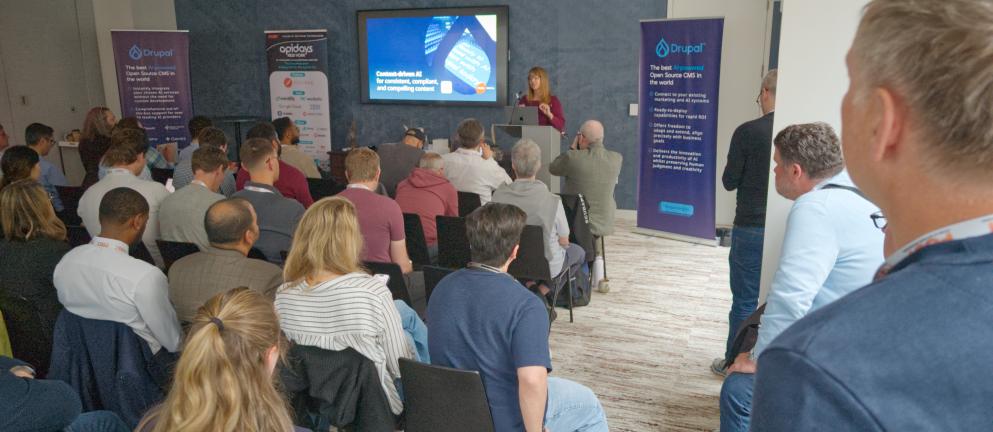
Where the broader enterprise tracks viewed APIs as rigid backend guardrails to keep AI contained, the Drupal tracks explored how these emerging agentic capabilities can transform actual user and author experiences. This was the core focus of my own presentation, "AI-driven DXP: New Horizons for Marketers":

While the enterprise is busy worrying about model optimization, the digital experience platform (DXP) ecosystem is looking at how agentic AI fundamentally redefines how marketing teams create, manage, and orchestrate content. In an AI-driven DXP, the traditional boundaries of content management melt away. Instead of treating the CMS as a passive repository, an ecosystem built on agentic AI allows marketers to deploy autonomous workflows that can intelligently adapt experiences, connect disjointed data sources, and scale personalization without requiring manual engineering oversight.
The summit beautifully balanced these high-level, future-forward visions of marketing horizons with real-world challenges that development teams are solving today.
Real-World Impact Over Slideware
Unlike the abstract trend-decking found elsewhere, the Drupal sessions were rich with actual deployment stories. The sessions demonstrated how the Drupal community is leveraging its enthusiastic embrace of agentic AI to "maintain our edge". A standout example included a highly practical, real-world case study showing how teams are using autonomous AI agents to seamlessly migrate an existing WordPress site into Acquia Source CMS:

The Difference is Striking
In sum, the contrast between the mainstream enterprise tracks and the Drupal AI Summit highlights a significant divergence in the evolution of the agentic web. While the broader industry focuses on cost management and proprietary guardrails, Drupal has found itself as the best CMS for AI. Drupal holds a significant advantage in today's agentic landscape thanks to its mature tooling for structured content, robust enterprise governance features, and an enthusiastic, collaboration-driven community. This unique combination of open-source agility and enterprise-grade architecture ensures that Drupal remains at the forefront of transforming user and author experiences in an AI-driven world.
