


Senior Product Marketing Manager Product Marketing Acquia
Collection
AEO Measurement: How Do You Know if You’re Winning in AI Search?
Collection :
Picture this: Your CMO leans across the conference table and asks, "How are we showing up in AI search?" and the room goes quiet. Not because your team isn't thinking about it. They are. But thinking about AI search and AEO measurement are two different things — and most teams are still in the first camp.
SEO has a 30-year measurement infrastructure. When the boss asks how organic search is performing, you can pull rankings, traffic, clickthrough rates, and domain authority data before the meeting ends. That infrastructure took decades to build, and it tells a clean story.
But answer engine optimization (AEO) — getting your brand cited in AI-generated responses — doesn't have that yet. Most teams are tracking it informally, if at all. Someone noticed a competitor showing up in a ChatGPT answer. Someone else checked whether the brand appeared in a Google AI Overview. And occasional pattern spotting is far from a measurement framework.
The pressure is real. Executives are asking, competitors are investing, and customers are starting their research in ChatGPT, Perplexity, and Google's AI Overviews, not in the ten blue links. The good news: you don't need to wait for the tools to catch up to start measuring.
The industry is still writing the AEO measurement playbook. But the reality is that leading indicators already exist, and the teams that start establishing baselines today will have a real advantage when the metrics mature.
Why Your Old Metrics Can’t Measure AI Search Performance
Your existing SEO metrics work exactly as designed, but they weren’t designed for AI search.
Organic traffic counts the people who clicked a link from a search results page. But when an AI gives someone a direct answer, that visit never happens. Your brand can be cited 10 times a day in AI Overviews and still not appear in your traffic report.
Referral traffic from AI tools is still worth tracking, but you’ll need different expectations than you'd have for Google. When someone searches Google and clicks a result, they land on your site. When someone gets an answer from Claude or ChatGPT, they may not click anything. The nature of the interaction is different — more like reading a summary than browsing — so referral traffic from AI tools will almost always look lighter than equivalent Google traffic, even if your brand visibility is strong.
Keyword rankings track how you perform in traditional search results pages. But LLMs don't rank pages; they generate answers. Ranking number two for a keyword means nothing if the AI never mentions you.
Traditional share-of-voice models were built for media and ad spend. They weren't designed for conversational queries, where the question is often "What should I do?" rather than "What is X?" Nor were they designed for situations where the answer comes from a model synthesizing hundreds of sources, not for serving a list of ten.
In other words, if you’re using existing metrics to determine your AEO performance, you're trying to measure a new channel with instruments built for an old one. But you aren’t starting from zero.
What You Can Measure Right Now
AEO measurement is still finding its footing, but there's more to work with than most teams realize. Here's what teams are tracking today:
- Brand mention frequency in AI answers. How often does your brand come up when someone asks an AI about your category? You can spot-check this manually, and a growing set of tools now automate it at scale.
- AI Overview presence. Google's AI Overviews appear at the top of results for a growing share of queries. Track which of your target queries trigger an AI Overview, and whether your content is cited inside it.
- Content citation signals. LLMs are more likely to cite authoritative, current, and well-structured content. Three factors matter here: structured data markup (so AI can parse your content reliably), E-E-A-T signals (experience, expertise, authoritativeness, and trustworthiness, Google's framework for evaluating content quality), and content freshness, meaning how recently a page was meaningfully updated.
- Category-level share of voice. When someone asks an AI about the category you compete in, are you part of the answer? Conductor's AEO/GEO Benchmarks Report provides baseline data on brand citation rates across industry categories, which can be useful for calibrating where you stand relative to the field.
One important caveat: these metrics are synthetic representations of what's happening, not direct readouts. Unlike Google, which exposes detailed query data through Search Console, LLMs don't give you a window into actual searches. Prompts are highly personalized, so no two users get identical answers. What the emerging tools provide is benchmark data — patterns across a defined set of test prompts — that gives you directional signals about whether your brand is part of the conversation.What marketing leaders are actually asking is more human than any of those metrics, though. A university wants to know: When a high school senior asks an AI about data science programs, do we come up? A hardware brand wants to know: When a homeowner searches for DIY project ideas, are our products in the answer? A consumer electronics company wants to know: When someone asks for speaker recommendations, do we get mentioned?
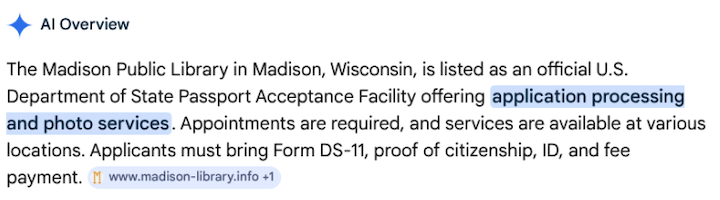
Measurement also protects you from something most teams haven't considered yet: catching misinformation before it spreads. For example, the Madison Public Library in Madison, Wisconsin, regularly gets visitors asking for passport photo services because AI tools are confusing them with the public library in Madison, Ohio, which actually offers that service. AI hallucinations about your brand don't just confuse potential customers; they can redirect them elsewhere or quietly erode trust. Knowing what AI is saying about you (accurately and inaccurately) is part of AEO measurement.
How to Build Your AEO Measurement Baseline
Getting started doesn't mean you have to have a perfect system; you just need one you can repeat. Here's what that looks like in practice.
Define target queries: Start with the questions your buyers are asking AI tools. Build on the keyword lists from your SEO platform, adding the real questions your buyers are typing into ChatGPT:
"What's the best CMS for a marketing team?"
"How do I measure content performance in AI search?"
Start with 10–15 queries that map to your core use cases and expand from there as you get a feel for the channel.
Manually audit: Run the queries yourself — manually, on a schedule. Once a month, put your target queries through ChatGPT, Perplexity, and Claude. For each one, note whether your brand was mentioned, where it appeared in the response, and whether the information was accurate. It's a simple system that gives you a paper trail and a way to show progress.
Identify content assets: Some of your content is far more likely to get cited than others. Long-form, well-structured content with clear authorship and current information tends to perform better. Content that answers specific questions directly is more naturally suited to how LLMs synthesize answers than content written primarily to rank for a keyword. Once you know which assets have the best shot at being cited, prioritize them for updates — freshen the information, tighten the structure, and ensure they have proper structured data markup.
Use the data: Raw audit notes aren't a measurement story. Once you have two or three months of data, look for patterns: queries where you consistently show up, queries where you don't, and places where AI is describing your brand inaccurately. That's where you focus next. Share a summary with your broader team so AEO visibility becomes part of the regular reporting conversation, not a side project.
Scale when you’re ready: Manual audits work well for building intuition and establishing a baseline, but most marketing teams eventually track hundreds (or thousands) of prompts across multiple topics, personas, and buyer stages. That's where purpose-built tools come in. Platforms like Acquia Content Optimization let you track LLM visibility at scale and connect what you're seeing to the actions that move the needle. For example, Acquia uses the platform internally to track 24 topics and 2,400 prompts, and we’ve seen a 25% quarter-over-quarter increase in brand visibility across LLMs as a result. It comes down to this: The manual phase gets you started. The right tools are what make AEO a repeatable, scalable discipline.
Extend, don't replace: Treat AEO measurement as an extension of your SEO reporting, not a replacement for it. Your existing measurement stack isn't going anywhere, and there's substantial overlap between what makes content rank well in search and what makes it get cited in AI. The goal is to add a new layer, not tear down what you've already built.
You’ve Been Here Before
Think back to the early days of social media marketing. We could all see that it was changing how people discovered and talked about brands, but nobody had figured out how to measure whether their efforts were working. We tracked engagement in screenshots. We calculated ROI based on best guesses. The marketers who leaned in anyway — who started building baselines before the tools caught up — were the ones who had an advantage when the channel matured.
Acquia customers like Woodruff Sawyer have seen organic search improve by 24% by treating content as a performance asset. AEO measurement works the same way. |
AEO is in that same moment. But this time, we already have a measurement model to build from. SEO gave us the framework: define the universe, establish baselines, track changes, and tie performance to outcomes. AEO measurement doesn't ask us to start from scratch. It asks us to extend what we've already built into a new channel. And the baseline you build today is the advantage you'll have tomorrow.
Want to see where your brand stands today? Request your Content Optimization demo to learn more about how to turn your content into a powerful growth engine. Short on time? Take a 90-second virtual tour of how Content Optimization works.