
The Multilingual AEM Alternative Built for Global Digital Experiences
Enterprises evaluating AEM alternatives for multilingual sites hit a common wall: AEM's translation is powerful, but costs compound with every language and market. Drupal—the most widely deployed open-source CMS in global enterprise—natively supports 100+ languages with no per-language fees.

Acquia's digital experience platform (DXP), built on Drupal, delivers that multilingual capability on a General Data Protection Regulation (GDPR)-compliant, managed infrastructure with $0 in licensing fees. In this guide, you'll see how Acquia compares to AEM on multilingual capability, what the real cost difference looks like, and why global brands are making the switch.
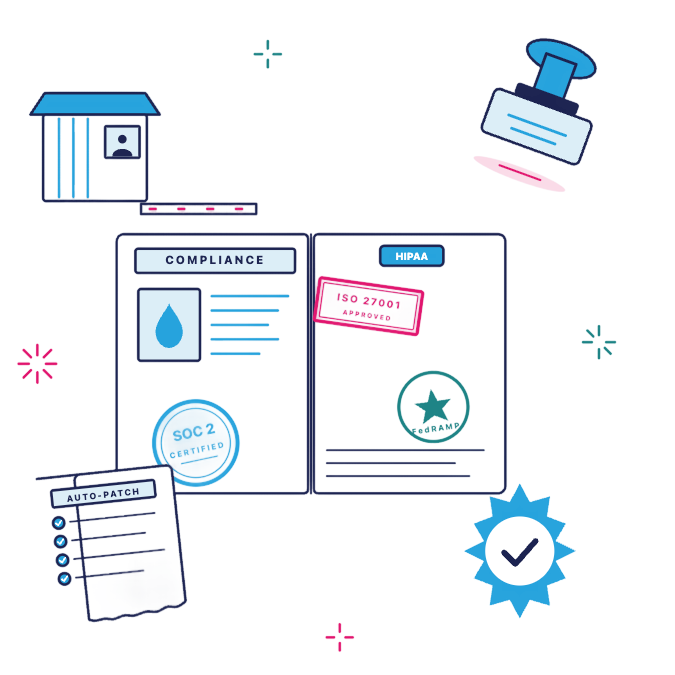
GDPR-COMPLIANT INFRASTRUCTURE
Acquia's platform is built to support General Data Protection Regulation (GDPR) compliance, with data processing agreements, data residency controls, and privacy-by-design infrastructure for organizations operating across the EU and globally.
Why Global Organizations Are Moving Away From Adobe AEM for Multilingual
Organizations managing digital experiences across multiple languages and regions consistently identify four pain points with AEM's multilingual model.

Translation costs that scale with every new language.
AEM's translation framework integrates with third-party translation management systems, but each integration and language addition carries licensing and configuration costs. For organizations expanding into new markets rapidly, that cost structure becomes a bottleneck—both financially and operationally. Drupal's native multilingual capability supports more than 100 languages in core, with no add-on licensing.
Content governance across languages is complex in a proprietary system.
Ensuring brand consistency across 10 or 20 language variants of the same content requires workflow controls that AEM makes complicated and costly to configure. Drupal's content translation system is built into core—not bolted on—making workflow management across languages significantly more accessible for editorial teams.
AEM implementation costs at global scale are prohibitive.
AEM enterprise implementations for global brands run $100,000–$1,000,000 per year in licensing, with implementation costs that can exceed $500,000 for multilingual, multi-region deployments. Acquia's open-source model eliminates licensing fees entirely, reducing total cost of ownership (TCO) by 60–80% for comparable global deployments.
Data sovereignty and regional compliance vary across markets.
Global organizations operating across the EU, APAC, and North America must manage data residency requirements that vary by jurisdiction. AEM's cloud architecture does not always provide the fine-grained data residency controls that GDPR and regional equivalents require. Acquia's platform supports data residency controls natively.
Adobe AEM vs. Acquia: Feature Comparison for Multilingual Websites
|
Feature / Capability
|
Acquia (Drupal)
|
Adobe AEM
|
|---|---|---|
|
Native Language Support
|
✅ 100+ languages native in core |
Limited — add-on integrations |
|
Translation Workflow
|
✅ Built into Drupal core |
Complex, third-party dependent |
|
GDPR Compliance
|
✅ Full data processing support |
Partial |
|
Data Residency Controls
|
✅ Native data sovereignty controls |
Limited |
|
Open Source Codebase
|
✅ 100% open source Drupal |
❌ Proprietary |
|
Multi-Site / Multi-Region
|
✅ Native via Site Factory |
Complex, costly |
|
Content Portability
|
High (open standard) |
Low (proprietary) |
|
Uptime SLA
|
✅ 99.95% guaranteed |
Varies |
|
Developer Ecosystem
|
1,000,000+ Drupal developers |
Adobe-certified only |
|
Summary |
Open, native 100+ languages, compliant |
Costly, complex, limited native ML |
Adobe AEM vs. Acquia: Feature Comparison for Multilingual Websites
|
Acquia (Drupal)
|
Adobe AEM
|
|---|---|
|
Native Language Support
|
✅ 100+ languages native in core |
Limited — add-on integrations |
|
Translation Workflow
|
✅ Built into Drupal core |
Complex, third-party dependent |
|
GDPR Compliance
|
✅ Full data processing support |
Partial |
|
Data Residency Controls
|
✅ Native data sovereignty controls |
Limited |
|
Open Source Codebase
|
✅ 100% open source Drupal |
❌ Proprietary |
|
Multi-Site / Multi-Region
|
✅ Native via Site Factory |
Complex, costly |
|
Content Portability
|
High (open standard) |
Low (proprietary) |
|
Uptime SLA
|
✅ 99.95% guaranteed |
Varies |
|
Developer Ecosystem
|
1,000,000+ Drupal developers |
Adobe-certified only |
|
Summary |
Open, native 100+ languages, compliant |
Costly, complex, limited native ML |
Total Cost of Ownership: Adobe AEM vs. Acquia for Multilingual
|
Cost Category
|
Acquia (3-Year Estimate)
|
Adobe AEM (3-Year Estimate)
|
|---|---|---|
|
Platform Licensing
|
$0 |
$300K–$3M |
|
Implementation
|
$100K–$300K |
$300K–$800K+ |
|
Ongoing Support
|
Included in platform tiers |
$100K–$300K/yr |
|
Developer Resourcing
|
Broad Drupal talent pool |
Adobe-certified (premium) |
|
3-Year Total (Est.) |
$300K–$900K |
$1M–$4M+ |
Total Cost of Ownership: Adobe AEM vs. Acquia for Multilingual
|
Acquia (3-Year Estimate)
|
Adobe AEM (3-Year Estimate)
|
|---|---|
|
Platform Licensing
|
$0 |
$300K–$3M |
|
Implementation
|
$100K–$300K |
$300K–$800K+ |
|
Ongoing Support
|
Included in platform tiers |
$100K–$300K/yr |
|
Developer Resourcing
|
Broad Drupal talent pool |
Adobe-certified (premium) |
|
3-Year Total (Est.) |
$300K–$900K |
$1M–$4M+ |
The multilingual gap between AEM and Acquia is not just about licensing—it is about the total cost of managing translation workflows, add-on integrations, and the Adobe-certified developer resources required to configure and maintain them. Acquia customers report an average 316% ROI over three years (Forrester TEI).
How a Global Brand Simplified Multilingual Content on Acquia

Challenge
A multinational consumer brand was managing regional websites across 14 language variants on AEM. Each new language market required custom integration work with AEM's translation framework, adding three to four months of implementation time per market expansion. Annual platform and translation integration costs exceeded $400,000.

Solution
The brand migrated to Acquia's Cloud Platform on Drupal, using Drupal's native multilingual content system for all 14 languages and adding three new language markets in the first year post-migration.

Outcome
Time to launch a new language market dropped from three to four months to three to four weeks. Annual platform costs fell by more than 60%. Editorial teams across all regional offices could manage translations directly within Drupal's interface, without requiring developer involvement for standard content updates.
Why Acquia Is the Global-Ready AEM Alternative for Multilingual
100+ Languages Native—No Add-Ons Required
Drupal's multilingual capability is built into core, not added as a paid module or third-party integration. Content translation, language detection, regional site configuration, and translation workflow management are all native capabilities. For global enterprises managing content across dozens of language variants, this reduces implementation complexity and eliminates the per-language add-on costs that make AEM expensive at scale.

GDPR and Regional Compliance Built In
Global digital experiences must comply with GDPR in the EU, Personal Data Protection Act (PDPA) in Singapore, Australia's Privacy Act, and similar frameworks across markets. Acquia's platform includes GDPR data processing agreements, data residency controls, and privacy-by-design infrastructure—giving global teams the compliance foundation they need without custom configuration for every market. This is a material advantage over AEM for organizations expanding into new regions with distinct data sovereignty requirements.
Multi-Region Site Management at Scale
Acquia Site Factory enables global organizations to manage dozens or hundreds of regional and language-variant sites from a single platform—with centralized code governance, centralized brand controls, and individual site autonomy for regional editorial teams. Brand consistency is maintained automatically; regional teams retain the flexibility to publish locally relevant content in their language without waiting for central IT involvement.

| How many languages does Drupal natively support? |
|---|
|
Drupal natively supports more than 100 languages in core, with built-in translation workflows, right-to-left language support, and language detection. No add-on licensing or third-party integration is required for standard multilingual content management. This is one of Drupal's strongest structural advantages over AEM for global enterprises.
|
| How does AEM's multilingual cost compare to Acquia for global organizations? |
|---|
|
AEM's multilingual deployments require third-party translation management integrations, per-language configuration costs, and Adobe-certified developer resources for setup and maintenance. Acquia's open-source Drupal model includes multilingual capability in core at $0 in additional licensing. Global enterprises typically reduce multilingual platform costs by 60–80% when migrating from AEM to Acquia.
|
| Does Acquia support GDPR compliance for organizations operating in the EU? |
|---|
|
Yes. Acquia's platform includes GDPR data processing agreements, data residency controls, and privacy-by-design infrastructure. This supports organizations operating under GDPR in the EU, as well as similar data protection frameworks in other regions (Singapore PDPA, Australia's Privacy Act, etc.).
|
| Can Acquia manage multi-region, multi-language site portfolios for global brands? |
|---|
|
Yes. Acquia Site Factory is built for exactly this use case—managing dozens or hundreds of regional and language-variant sites from a single platform with centralized governance and individual site flexibility. Global brands use Site Factory to maintain brand consistency while giving regional editorial teams the autonomy to publish locally relevant content.
|
| How long does an AEM-to-Acquia migration take for a multilingual global website? |
|---|
|
Migration timelines vary by content volume, number of languages, and regional complexity. Most global multilingual migrations from AEM to Acquia are completed in six to twelve months, with language variants migrated in phased batches. Acquia's Professional Services team specializes in global multilingual migrations.
|
| Does Drupal support right-to-left languages like Arabic and Hebrew? |
|---|
|
Yes. Drupal's multilingual system natively supports right-to-left (RTL) languages, including Arabic, Hebrew, Persian, and Urdu. Theme and layout adjustments for RTL are supported in the core admin interface and in Drupal's theming system.
|
Ready to Simplify Global Content Management?
Global enterprises should not pay $400,000+ per year for multilingual capabilities that Drupal delivers natively at zero licensing cost.