


Senior Product Marketing Manager Product Marketing Acquia
Collection
AI Search Rewards Fresh Answers. Most Content Teams Can't Keep Up
Collection :
AI answer engines cite brands that publish clear, current answers to the questions buyers ask, at whatever point in their research they ask them. Your marketing team probably knows which questions matter, but turning an approved idea into a live page can take weeks. By then, AI engines may be citing someone else.
This post is for marketing leaders who've accepted that AI has changed the buyer journey and now need to figure out how their content operations can keep up. We’ll cover how buyers use AI search, where content production slows down, and what to change so your team can publish faster.
Key takeaways
|
How has AI search changed the buyer journey?
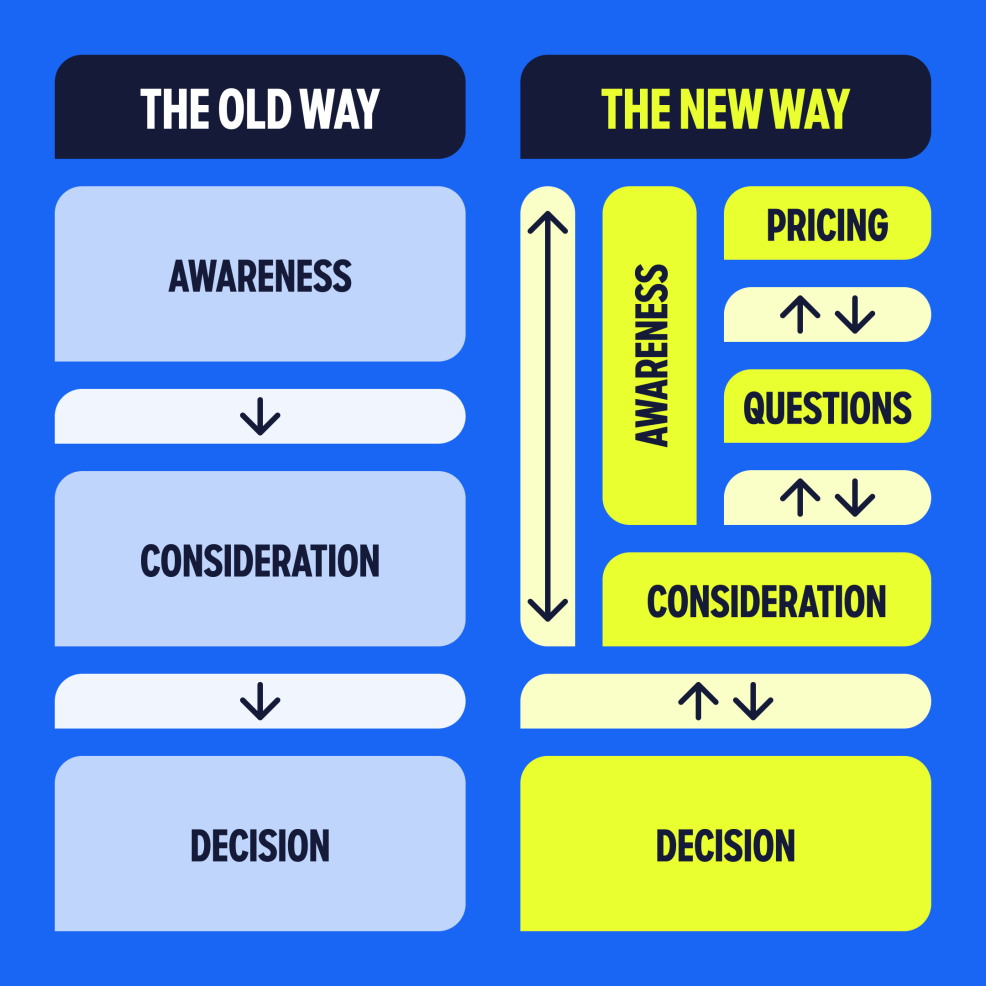
AI search has turned the buyer journey from a linear funnel into a set of questions that buyers ask in whatever order suits them. Instead of moving from awareness to consideration to decision, a buyer may start with a question about pricing, then ask for a basic definition of the solution category, then ask about implementation, all in the same session. At each step, the AI answer engine decides which sources they see.
In an AI-mediated buyer journey, planning content by funnel stage leaves too many questions unanswered. A nonlinear buyer journey content strategy starts with identifying the questions each persona asks at any stage, and ensuring your brand has a clear, up-to-date answer to each one.
The goal of AI answer engine optimization is to get cited in the answer rather than rank on a search results page. That means your content has to be structured for machines as well as people, and most CMOs say theirs isn't there yet. In 2026 research commissioned by Acquia, 56% said their content is built for people to read but not structured for AI.
Why does content production slow down AI search visibility?
At many organizations, content passes through so many handoffs that a new page can take weeks to go live. See if this blog post publishing sequence sounds familiar:
- A requester submits the idea, and a content lead triages it and assigns a writer.
- The writer asks product marketing for messaging and proof points, then books time with a subject-matter expert.
- The requester approves an outline, the writer drafts, and an editor sends back style edits.
- SEO and AEO specialists add keywords, a title tag, a meta description, and the structure AI engines look for, like direct answers and FAQ markup.
- Product marketing checks accuracy, and legal or brand reviews the claims.
- Creative searches for images or makes new ones.
- A web producer builds the page in the CMS.
- The requester gives final approval, and the post goes live.
- Social and email get a separate request for promo copy.
On their own, each of those steps makes sense. Together, they add up to more than a dozen handoffs across eight or more teams. That means that the brief approved in your Tuesday meeting may not have a live URL for five weeks — and that AI has found another source for the answer in the meantime.
AI tools haven't shortened this process for many teams. While each person gets faster at their own step, the post still sits in the same review queue and waits for the same page build. Updates to existing posts and pages follow the same pattern. For fast-moving topics, AI engines tend to favor up-to-date sources. If your team can't refresh a page quickly when something changes, a competitor with a more current answer can take citations you once earned.
To find your content production bottleneck, start with three questions:
- How long does it take to go from an approved brief to a live URL?
- How many handoffs happen along the way, and who owns each one?
- Would you know if a competitor got cited on a question your team already had an answer to?
How can marketing teams increase content velocity?
Content velocity is the speed at which a team moves content from idea to a published page. Teams improve content velocity by removing handoffs so fewer people and systems sit between an insight and a live page. Asking a team to move faster within the old process only gets you so far; four changes make a big difference.
- Create one source of truth: Put positioning, approved proof points (and their sources), personas, product names, and brand voice in one knowledge base that people and AI tools both draw from. Writers can stop chasing product marketing for basic info.
- Turn repeat work into reusable workflows: The steps you take on every piece, like intake, drafting to a set structure, style and claims checks, and asset searches, only need to be built once. If your team has done something three times, it’s a good candidate.
- Build governance into the workflow: Someone approves the brief and reviews the AI draft. Automated checks flag brand, style, and claims issues along the way, and a person still signs off before anything goes live.
- Take the page build out of the dev queue: This is often where content waits longest, because new pages compete for developer time with everything else on the roadmap. The fix is a CMS that lets marketers build and publish pages themselves, with governance still in place. Acquia Source CMS does this from a single prompt or a drag-and-drop interface, and its AI Site Builder cuts site build time by up to 85%.
For the team in that Tuesday meeting, making these changes can turn a five-week wait into a few days, with the same brief and the same people.
At Acquia, our marketing team has been running this approach internally. After restructuring our content for people and AI and turning repeat work into reusable workflows, we’ve seen 21% more AI citations quarter over quarter and saved about two hours on each blog post we publish. One page we updated through the new workflow saw time on page rise 15%.
Customers are seeing a similar shift on the build side. Conagra Brands used AI-assisted development with Acquia Source to speed up its web rebuilding initiative.
How Acquia Source shortens the time to publish
Visibility tools show your team which questions to answer. Production speed decides whether your answer is live in time to get cited.
Acquia Source connects your content, digital assets, and governance workflows with AI, so fewer steps sit between an approved idea and a live page. Marketers can build and publish pages themselves, without waiting on a dev queue. The next time your team spots a question buyers are asking, you can have the answer live while it still counts.
Want to see how your team can get from insight to a live page faster? Book an Acquia Source Demo.


