
The FedRAMP-Authorized AEM Alternative for Government Agencies
When government agencies evaluate AEM alternatives, one requirement supersedes the rest: FedRAMP authorization. Adobe Experience Manager has documented challenges meeting federal security requirements—a gap that leaves agencies exposed or stalled.

Acquia's digital experience platform (DXP), built on Drupal, holds FedRAMP authorization and is purpose-built for government digital services, at a cost that is a fraction of AEM's $100,000–$1,000,000 annual price point. In this guide, you'll see why agencies are replacing AEM, how Acquia compares on every dimension that matters to government IT directors, and what a migration looks like.
FEDRAMP AUTHORIZED
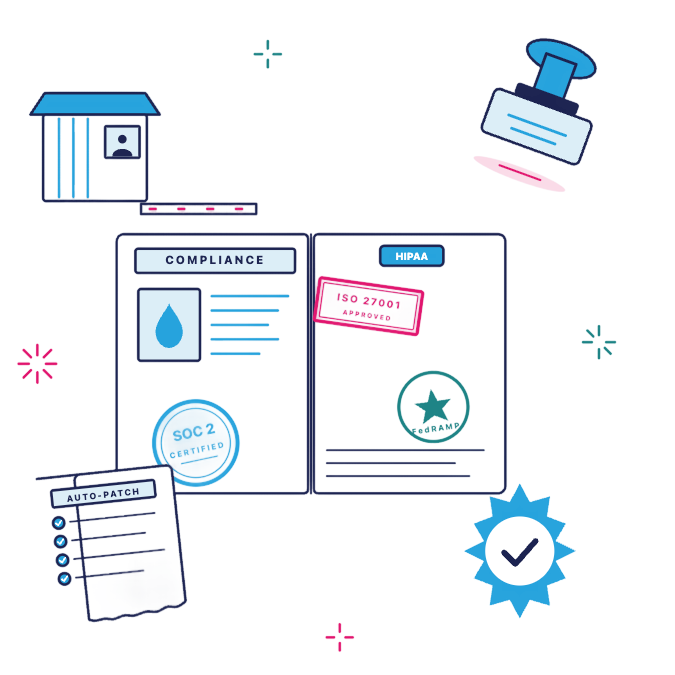
Acquia holds Federal Risk and Authorization Management Program (FedRAMP) authorization, meeting the rigorous security standards required by U.S. federal agencies. Unlike many enterprise content management systems (CMS), Acquia is purpose-built to support federal digital services with authority to operate (ATO) readiness and full data sovereignty.
Why Government Agencies Are Moving Away From Adobe AEM
Federal and state IT directors cite four structural barriers when evaluating whether to stay on AEM.




FedRAMP authorization is a hard requirement AEM struggles to meet.
U.S. federal agencies cannot procure cloud software without FedRAMP authorization. AEM's FedRAMP status has been inconsistent and incomplete, creating a procurement barrier for agencies that need an authority to operate (ATO) before deployment. Acquia is FedRAMP authorized—full stop.
Cost at government scale is unsustainable.
AEM enterprise licensing runs $100,000–$1,000,000 per year depending on scale and modules. For agencies managing constrained IT budgets across multi-year appropriations, that cost is increasingly difficult to justify against open source alternatives with $0 licensing fees.
Vendor dependency conflicts with government open-source policy.
Federal IT policy increasingly favors open source software (OSS) to reduce vendor lock-in and support long-term sustainability. AEM's proprietary architecture conflicts directly with that direction. Drupal—the foundation of Acquia's platform—is the most widely used CMS in government globally.
Data sovereignty and residency controls are non-negotiable.
Government agencies require full control over where data lives, who can access it, and under what conditions. AEM's cloud architecture does not always provide the data residency controls federal agencies need. Acquia's platform supports data sovereignty requirements natively.
Adobe AEM vs. Acquia: Feature Comparison for Government
|
Feature / Capability
|
Acquia (Drupal)
|
Adobe AEM
|
|---|---|---|
|
FedRAMP Authorization
|
✅ Fully FedRAMP authorized |
❌ Incomplete / not standard |
|
ATO Readiness
|
✅ Built for federal ATO processes |
❌ Not purpose-built |
|
Open Source Codebase
|
✅ 100% open source Drupal |
❌ Proprietary |
|
Licensing Cost
|
$0 licensing fees |
$100K–$1M/yr |
|
Data Sovereignty Controls
|
✅ Full data residency control |
Limited |
|
HIPAA BAA Capability
|
✅ Available |
❌ Not standard |
|
SOC 2 Type II Certification
|
✅ Certified |
Partial |
|
Developer Ecosystem
|
Global Drupal + Acquia experts |
Adobe-certified only |
|
Uptime SLA
|
✅ 99.95% guaranteed |
Varies |
|
Summary |
Authorized, open, cost-efficient |
Costly, FedRAMP gap, proprietary |
Adobe AEM vs. Acquia: Feature Comparison for Government
|
Acquia (Drupal)
|
Adobe AEM
|
|---|---|
|
FedRAMP Authorization
|
✅ Fully FedRAMP authorized |
❌ Incomplete / not standard |
|
ATO Readiness
|
✅ Built for federal ATO processes |
❌ Not purpose-built |
|
Open Source Codebase
|
✅ 100% open source Drupal |
❌ Proprietary |
|
Licensing Cost
|
$0 licensing fees |
$100K–$1M/yr |
|
Data Sovereignty Controls
|
✅ Full data residency control |
Limited |
|
HIPAA BAA Capability
|
✅ Available |
❌ Not standard |
|
SOC 2 Type II Certification
|
✅ Certified |
Partial |
|
Developer Ecosystem
|
Global Drupal + Acquia experts |
Adobe-certified only |
|
Uptime SLA
|
✅ 99.95% guaranteed |
Varies |
|
Summary |
Authorized, open, cost-efficient |
Costly, FedRAMP gap, proprietary |
Total Cost of Ownership: Adobe AEM vs. Acquia for Government
|
Cost Category
|
Acquia (3-Year Estimate)
|
Adobe AEM (3-Year Estimate)
|
|---|---|---|
|
Platform Licensing
|
$0 |
$300K–$3M |
|
Implementation
|
$100K–$300K |
$300K–$1M+ |
|
FedRAMP Compliance Work
|
Low (authorization already held) |
High (gaps require custom remediation) |
|
Ongoing Support
|
Included in platform tiers |
$100K–$300K/yr |
|
Developer Resourcing
|
Broad Drupal talent pool |
Adobe-certified (premium rates) |
|
3-Year Total (Est.) |
$300K–$900K |
$1M–$5M+ |
Total Cost of Ownership: Adobe AEM vs. Acquia for Government
|
Acquia (3-Year Estimate)
|
Adobe AEM (3-Year Estimate)
|
|---|---|
|
Platform Licensing
|
$0 |
$300K–$3M |
|
Implementation
|
$100K–$300K |
$300K–$1M+ |
|
FedRAMP Compliance Work
|
Low (authorization already held) |
High (gaps require custom remediation) |
|
Ongoing Support
|
Included in platform tiers |
$100K–$300K/yr |
|
Developer Resourcing
|
Broad Drupal talent pool |
Adobe-certified (premium rates) |
|
3-Year Total (Est.) |
$300K–$900K |
$1M–$5M+ |
Agencies that move to Acquia report an average 316% ROI over three years (Forrester TEI). For government procurement teams working within fixed budget cycles, the total cost of ownership (TCO) difference is a decisive factor.
How NASA.gov Runs Mission-Critical Digital Services on Drupal

Challenge
NASA.gov is one of the most visited government websites in the world, requiring a platform that can handle massive scale, meet strict federal IT compliance standards, and support mission-critical digital services without compromise.

Solution
NASA chose Drupal — the same open source foundation that powers Acquia's platform — to run NASA.gov, demonstrating that open source CMS technology is both technically sound and compliant with federal IT policy.

Outcome
NASA.gov stands as a proof point for government agencies evaluating a move from AEM: open source Drupal is not just viable at federal scale — it is the platform of choice for mission-critical digital services.
Why Acquia Is the Government-Ready AEM Alternative
FedRAMP Authorization That Removes Procurement Barriers
Acquia is FedRAMP authorized, which means federal agencies can proceed with procurement without requiring custom security assessments or gap remediation. ATO readiness is built into the platform architecture—not added on after the fact. For state and local agencies that follow FedRAMP-equivalent frameworks, Acquia's compliance posture satisfies those requirements as well.

Open Source That Aligns With Federal IT Policy
Drupal is the most widely deployed CMS in government globally. It powers federal, state, and municipal sites across every major democratic nation. Its open source architecture means no proprietary lock-in, full code transparency for security audits, and a global developer community that ensures long-term platform sustainability. Acquia adds the managed infrastructure, security layer, and dedicated support that government agencies need on top of that foundation.
Proven Scalability for Multi-Agency Digital Services
Government agencies often manage dozens or hundreds of digital properties—department sites, program hubs, public-facing portals, and more. Acquia Site Factory enables centralized management of multi-agency site portfolios with site isolation, centralized code governance, and automated updates—all within a FedRAMP-authorized environment.

| Is Acquia FedRAMP authorized? |
|---|
|
Yes. Acquia holds FedRAMP authorization, making it one of the few enterprise Drupal platforms that meets the procurement requirements of U.S. federal agencies. Acquia's FedRAMP authorization supports ATO readiness for agency deployments.
|
| Does Adobe AEM have FedRAMP authorization? |
|---|
|
AEM's FedRAMP status has been inconsistent and is not available as a standard offering for all AEM configurations. Federal agencies require complete FedRAMP authorization as a procurement prerequisite—a gap that has blocked or delayed many AEM deployments in the federal space.
|
| How much does Adobe AEM cost compared to Acquia for government agencies? |
|---|
|
AEM enterprise licensing runs $100,000–$1,000,000 per year, before implementation and support. Acquia's open-source Drupal model carries $0 in licensing fees. Over a three-year contract period, agencies typically reduce platform spend by 60–80% when migrating to Acquia.
|
| Can Acquia replace Adobe AEM for federal agency websites? |
|---|
|
Yes. Acquia's Cloud Platform supports all the core use cases federal agencies run on AEM—public-facing websites, department portals, multilingual content, multi-site management, and more—within a FedRAMP-authorized, ATO-ready infrastructure.
|
| Is Drupal widely used in government? |
|---|
|
Yes. Drupal is the most widely used open source CMS in government globally. NASA.gov, numerous federal agency sites, and thousands of state and local government properties run on Drupal. Its open source architecture, security track record, and compliance documentation make it the default CMS for government digital services.
|
| How long does an AEM-to-Acquia migration take for a government agency? |
|---|
|
Migration timelines vary by site complexity and procurement cycles. Typical government agency migrations run nine to eighteen months. Acquia's Professional Services team has experience navigating government procurement requirements and security review processes.
|
| What compliance certifications does Acquia hold relevant to government? |
|---|
|
Acquia holds FedRAMP authorization, SOC 2 Type II certification, HIPAA BAA capability, PCI DSS compliance, and GDPR data processing support. This compliance portfolio is the most comprehensive available on a Drupal platform.
|
| Does Acquia support data sovereignty requirements for government agencies? |
|---|
|
Yes. Acquia's platform supports data residency controls and data sovereignty requirements, allowing agencies to specify where data is stored and processed. This is a critical requirement for federal and defense-adjacent agencies that AEM's cloud architecture does not always satisfy.
|
Ready to Replace Adobe AEM?
Government agencies deserve a platform that is FedRAMP authorized from day one—not one that requires custom compliance work to get there.