Your Next Buyer Sends an Agent First: A Practical Guide to B2A Marketing

Collection :
Picture the chief digital officer of a respected university. Last year, the team passed on a program to prepare its content for AI agents. It stuck with what had always worked: enrollment fairs, paid media, and the website.
Now enrollment is flat, and nearby schools are growing. The difference? When prospective students ask an answer engine about programs, agents can find and use the content on those rival sites. Some agents can even fill out their inquiry forms. Meanwhile, the university's own pages are so outdated that third-party sites describe its faculty better than it does.
Chuck Gahun, Vice President and Principal Analyst at Forrester, opened a recent keynote with that scenario. He built it for higher education, but he said he has had the same conversation all year with leaders in government, retail, and other industries. Agents are already training on experiences we designed for human emotion. What they take away about our products is often incomplete.
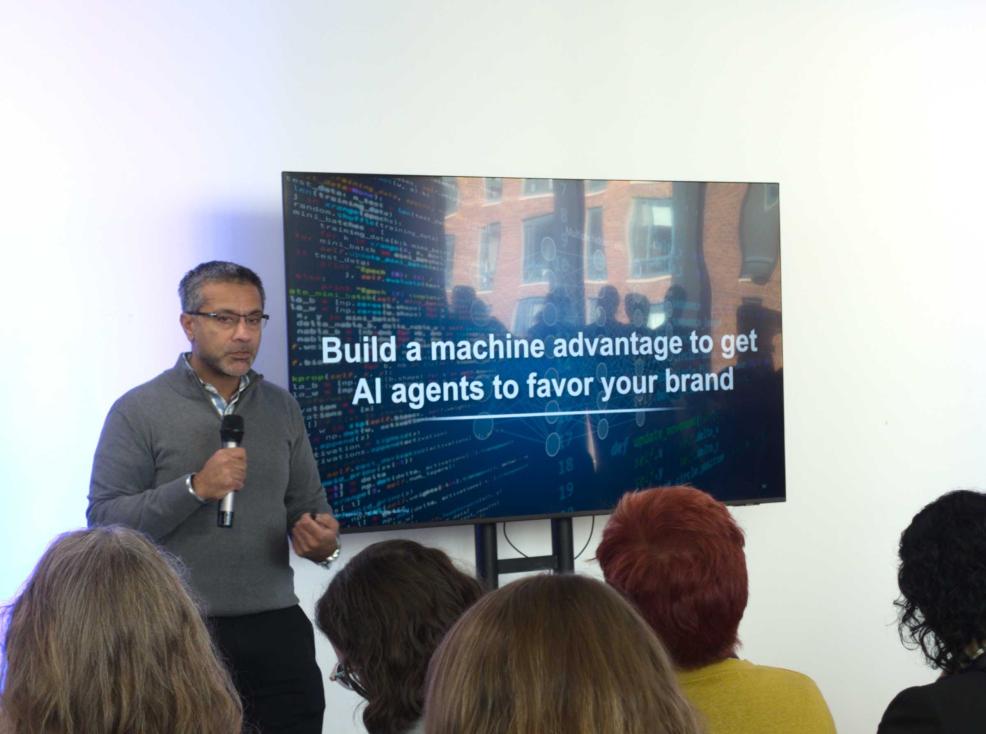
Gahun's name for the evolving response is B2A marketing: business-to-agent. It is a strategy for B2B and B2C organizations alike, designed to reach machine customers. Here's what I took from his talk, and why Drupal is well placed to help organizations act on it.
Meet your newest persona
Forrester defines AI agents as applications that act on behalf of an enterprise or a person. They perform tasks and make decisions, and they act with some level of autonomy. Gahun suggests treating the agent as a persona in its own right, with needs that differ from the humans it serves.
People | AI agents |
Shaped by identity | Shaped by the value they can return to their user |
Influenced by trusted relationships | Influenced by trusted context |
Follow journeys a marketer designed | Retrieve content and generate a one-time answer |
Limited by cognitive load | Limited by context windows |
Reason from lived experience | Reason from pattern recognition |
Work set hours | Work around the clock, focused on the task |
The audience is also more varied than it was a year ago. When Gahun first built this research, the conversation was mostly about the crawlers that train answer engines. Now he tracks three groups. Training crawlers feed the foundation models. Brand agents, such as a retailer's shopping assistant, help you find a product while serving the retailer's goals. Personal agents work for the consumer and may know far more about that person than any brand does.
That last group is the one to watch. A brand agent might know you are shopping for hiking boots. Your personal agent knows you hike every fall, bought boots last year, and probably need a bigger backpack now that your kids are older. Gahun calls this an informational asymmetry between brands and consumers, and it will reshape commerce and content alike.
Why an old landing page can cost you a customer
The experiences we build for people are deterministic. Navigation, forms, and even most chatbots walk visitors down a path someone planned. Answer engines are different. They pull from whatever they have seen and generate a fresh answer for each prompt.
So think about the landing page for a retired product that nobody took down three years ago. A crawler has likely read it. When a buyer asks a question, the answer engine may use that page to build a one-time response. The buyer closes the window, the answer may never appear again, and their view of your brand has already shifted.
Many leaders do not see this risk yet. In Forrester's 2026 State of AI survey of 1,957 AI decision makers, 61% said generative AI always produces the same output for the same prompt. And 76% said generative models are good at looking up and validating facts. Marketing and content teams are making their case to customers and, at the same time, to their own executives.
The stakes keep rising. Gahun described agent use moving past product discovery into comparison, inquiry forms, and the start of B2B negotiation. Consumers ask agents to schedule healthcare appointments, plan trips around a budget and a school calendar, review a mobile plan before traveling abroad, and explain what documents to bring to a government office. Answer engines return answers, not a list of links to sort through.
What the agent persona is looking for
An agent arrives with a job. It wants a task completed or a specific piece of information, and then it leaves. Gahun's research found three things it looks for.
Context, so it can serve the human. Your website is part of the training set, but it is not the whole set. Review sites, forums, and partner pages may say more about your products than you do. Assuming you can ignore those sources is a mistake. You need to know what is being said about your brand everywhere an agent might look.
Fluency, so it can reduce guesswork. Agents do not browse a UI. They retrieve content and data, and they either get what they came for or they do not. That puts a premium on information structure, clean data, and shared vocabulary. If the market says "running shoes" and your catalog says "running sneakers," you have made the agent's job harder. Access matters too. If an agent cannot reach or parse your pages, nothing else counts.
Trust, so its answer holds up. An agent asks what it can verify. It weighs topical depth, publishing frequency, and whether other sources corroborate your claims. The answer engine providers want accurate answers, and they reward the sources that help them give one.
Gahun frames the goal as machine advantage. Businesses have spent decades building competitive advantage with people. Now they need to prepare their organizations to win with machines as well.
Six steps to build for people and agents at once
Gahun organizes the work around consideration, relevance, and retention: get surfaced, be relevant to the prompt, and give agents a reason to treat you as the authoritative source. Here is how that translates into practice.
1. Get into the consideration set
Start with visibility. Implement schema markup, make sure the agents you want can reach your pages, and find and retire the outdated content that is quietly shaping answers today. This can also mean carefully consider which bots you're blocking at your firewall.
2. Choose a horizontal or vertical content strategy
A vertical strategy goes deep on one product or use case. A horizontal strategy educates the market on the whole category. Gahun described how JBL chose to own the broader story of headphones and music, rather than only headphones for runners or for audiophiles. Horizontal takes more effort, but it prepares answer engines for a wider range of questions.
Either way, look for the white space. Everyone will publish "the best headphones for runners." Fewer brands will answer "which headphones still hold up against sweat four years later." Those specific questions are where you can teach the answer engine something new.
3. Make every asset work twice
Gahun calls this dual optimization: content built for human persuasion and machine training at the same time. For the 2025 holiday season, JBL cut its YouTube content into short snippets. Each snippet had a version for people and a machine-structured version for answer engines. Gahun could not share the numbers, but he said the gains were significant.
The spec-heavy B2B pages many marketers have tried to retire are useful here. Most buyers skim them, but an engineer sizing a component reads every line, and so does an agent. Authentic human content matters too. Forrester found that 52% of marketing and advertising decision makers expect to invest more in user-generated and influencer content, and it predicts more human-generated content in 2027 for machines to amplify.
4. Build fluency into your information architecture
Topic clusters, FAQ content, and short content snippets help agents find what they need. Context files written in Markdown are gaining attention, though Forrester has not yet seen evidence that agents use them, so treat them as an experiment. The most interesting one to Gahun is a tone and language file, which could help answer engines describe you in your own brand voice.
Then test yourself. If an agent visits your site, can it drive a conversion? Does your information architecture show topical authority in your field?
5. Keep your story consistent everywhere it appears
Agents learn from every site that talks about you, including the ones you do not run directly. In 2025, General Motors funded a content program across its dealer sites so the GM narrative carried through to each one, while dealers kept the flexibility to highlight local specials. Within about three to four months, Gahun said, answer engines reflected that consistent message, and GM saw a significant impact on its business.
6. Own the hard stories
Retention also depends on how you handle what goes wrong. Gahun spoke with a B2B parts manufacturer whose first release of a product failed badly. Customers said so on Reddit, and answer engines repeated it. The company added FAQ content to the product page that addressed the criticism directly. It explained what went wrong in the first release and what changed in each revision since, with customer success stories. Three to four months later, answer engines told the full story.
Then decide what flows through the agentic channel
Much of 2026 has been about opening sites to agents. Fewer teams have asked which products and services they want to offer through that channel. Some retailers are opening gateways for agents and setting the terms of trade, while some airlines block bots from tasks such as check-in. Gahun now hears retailers ask whether to launch a product to agents first, to build demand before people see it. Each organization will need its own answer.
Why Drupal is ready for B2A
Gahun put it plainly: brands have spent decades persuading people, and the job is now less about storytelling and more about content and data structure. That is where Drupal has always lived.
Structured content is the native format
Drupal has spent more than 20 years treating content as structured data. Content types, fields, taxonomy, and entity relationships give every product, program, or article a defined shape, and Drupal enforces that shape before anything reaches the database. That is the information structure agents look for.
It also makes dual optimization practical. One structured entity can render as a page for people and as clean data for machines, through JSON:API in Drupal core and schema.org markup from contributed modules. Taxonomy gives teams one place to manage vocabulary, so "running shoes" and "running sneakers" point to the same thing. Revisions and editorial workflows help teams find and retire the stale pages that mislead answer engines.
For organizations with many sites, such as the GM dealer network, consistency is a platform question. Acquia Multi-Experience Operations (MEO) manages many Drupal sites from one codebase, so a shared content model and narrative can reach every site while local teams keep control of their own details.
Agentic capabilities are a community priority
Acquia was a founding member of the Drupal AI Initiative, which launched in June 2025. By June 2026, the initiative spanned 32 organizations and more than 50 contributors, shipping against a public roadmap. Its work now runs in two streams. Inside AI brings AI into the Drupal interface for the people who use it. Outside AI makes Drupal the platform that external agents reach for and act on.
That second stream answers Gahun's university scenario directly. With the Tool API, site builders define actions with typed inputs and outputs that AI agents and MCP clients can discover and run. The MCP Server module then exposes approved tools to external agents, with OAuth 2.1 for access control. In practice, an agent could submit an inquiry or check eligibility through an action you defined and approved, without scraping a form built for people. Community contributors describe this as a shift from publishing pages to publishing capabilities.
Governance comes built in. Agents can be limited to specific tasks, and tools can check permissions before they act, so you decide what flows through the agentic channel.
An open community moves at the speed of the market
Gahun said his research started with a challenge: our investment is training the AI, so why are we not driving the train? With a proprietary platform, you wait for a vendor roadmap. With Drupal, organizations shape the roadmap themselves. When a new protocol or practice appears, contributors can build, test, and share support for it in the open, and everyone benefits from the result.
Acquia is the largest corporate contributor to Drupal, and Acquia engineers hold 10 of the 20 Drupal Core Leadership team positions. That gives our customers early visibility into where the platform is heading, including its work on agents.
Start before the crawlers finish
In Gahun's university story, the team asked how long the fix would take. The answer was weeks, if not months, because a content strategy for people and agents is not an overnight change. Meanwhile, training crawlers are learning from your site as it exists today, and agents are trying to act on it.
The practical first moves are clear. Find out what answer engines say about you now. Retire the pages that tell the wrong story. Pick a horizontal or vertical strategy, and model your content so it serves people and machines from the same source. If your platform already speaks structured content and is building for agents in the open, you are starting from a stronger position.