


Director, Analyst & Media Relations Marketing Acquia
Collection
What Developers Want From a CMS: 2026 Survey Findings
Collection :
What do developers want from a CMS? Acquia recently surveyed 575 developers to find out. Security wins when they're choosing a platform, but AI readiness is what makes them leave one.
We wanted to hear from the people who build on content platforms every day, because most buying decisions include them. 80% of the developers we surveyed are involved in choosing the CMS their organization or clients use.
Here's what they told us about how they evaluate, choose, and leave a platform, and what it means if you're part of that decision
About the survey: Acquia commissioned research firm Coleman Parkes to survey 575 web developers in the United States, United Kingdom, and France from July 7 to July 29, 2026. Respondents work in-house, at agencies, and as freelancers, across both the public and private sectors. Coleman Parkes also surveyed 250 CIOs and CTOs in the same three markets, and we've noted where their answers line up with developers' or differ. Full methodology is at the end of this post.
The findings at a glance
Here's what 575 developers told us in Acquia's 2026 survey:
- 53% would leave a platform that isn't a good fit for AI or agentic workflows, the top reason other than cost.
- 56% rank security in their top three buying criteria, more than any other factor.
- 54% started their last CMS evaluation after hitting the limits of their current platform.
- 58% say integrating AI tools into their workflow is a top-three priority right now.
- 53% want a platform they won't have to fully rebuild as AI evolves.
- 51% turn to developer forums when researching a CMS, and 49% ask an AI assistant.
How do developers decide it’s time for a new CMS?
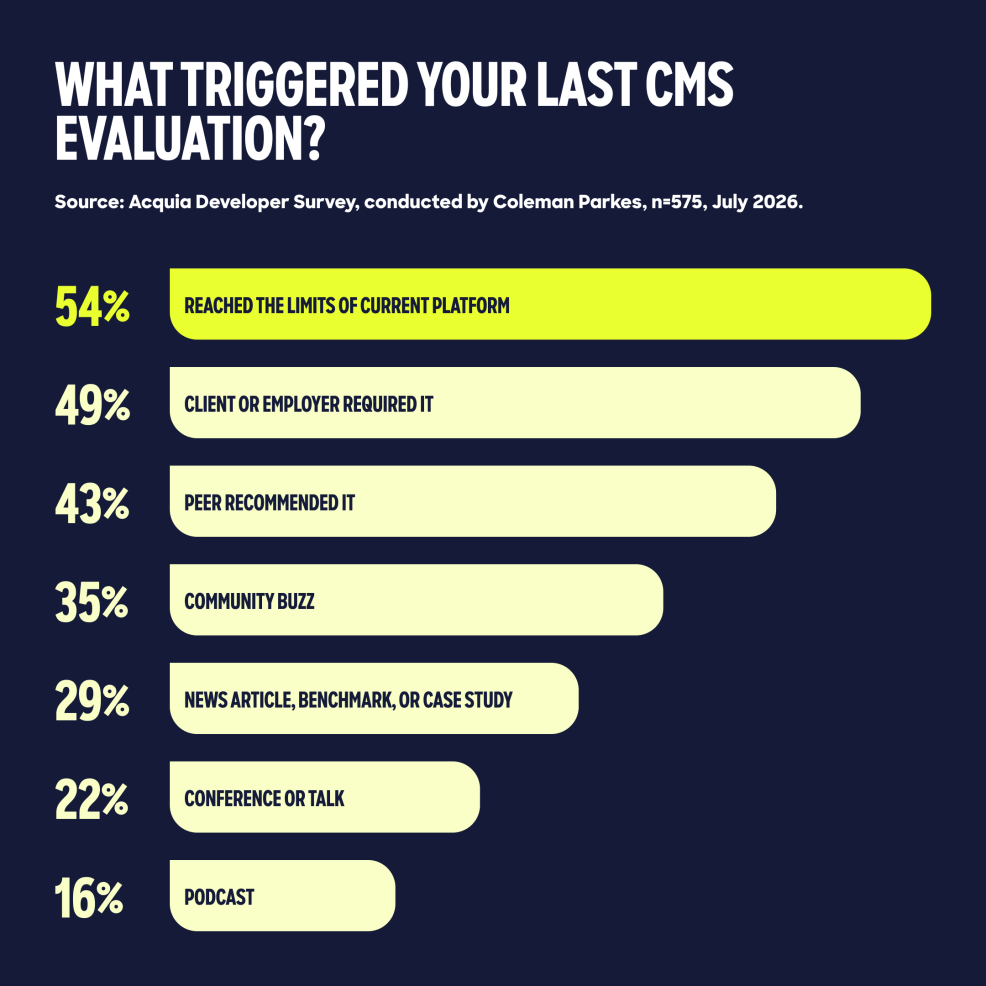
Most developers start looking for a new CMS when they hit the limits of their current system. In our survey, 54% said reaching the limits of their current platform on a project triggered their last CMS evaluation. Close behind, 49% said a client or employer required it, and 43% said a peer recommended a platform. In other words, most evaluations stem from friction, not curiosity.
Developers also pay attention to what's happening online. Buzz on GitHub, Reddit, and X came in at 35%, ahead of news articles and case studies (29%) and conferences (22%). If you want to know what your peers think of a platform, you're more likely to find out in a thread than at a keynote.
And developers aren't the only ones feeling boxed in. The people signing off on the decision feel the same friction, even more often: 67% of CIOs and CTOs started their last evaluation after reaching the limits of their current platform.
What do developers look for when choosing a CMS?
Security is easily the top priority that developers look for in a CMS. 56% of respondents ranked security among their top three CMS selection criteria, and 26% ranked it first.
Performance and the ability to scale come second at 49%, and AI and agentic readiness is third at 40%. After that, the numbers drop off: predictable total cost of ownership (33%), roles and permissions management (32%), and support for preferred coding languages (29%).
It doesn't matter much whether developers already work in Drupal. Both groups put security, performance, and AI readiness at the top. The only difference is that Drupal developers weigh performance and AI readiness equally, at 44% each.
CIOs and CTOs agree with developers on the top two. 73% name CMS security as one of the most important factors in a CMS decision, and 64% name performance and scale. Where they split from developers is AI. Agentic readiness is their second-lowest factor of nine (42%), ahead of only personalization.
![Bar chart showing security ranks first among developer buying criteria at 56%, followed by performance at 49% and AI readiness at 40%.]](/sites/default/files/styles/wysiwyg_full_no_crop_/public/media/image/2026-10/Blog-What%20Developers%20Want%20From%20a%20CMS%202026%20Survey%20Findings-Chart%202-Social%20%281080%20x%201080%29.png?itok=J__nTIb_)
Why do developers leave their CMS?
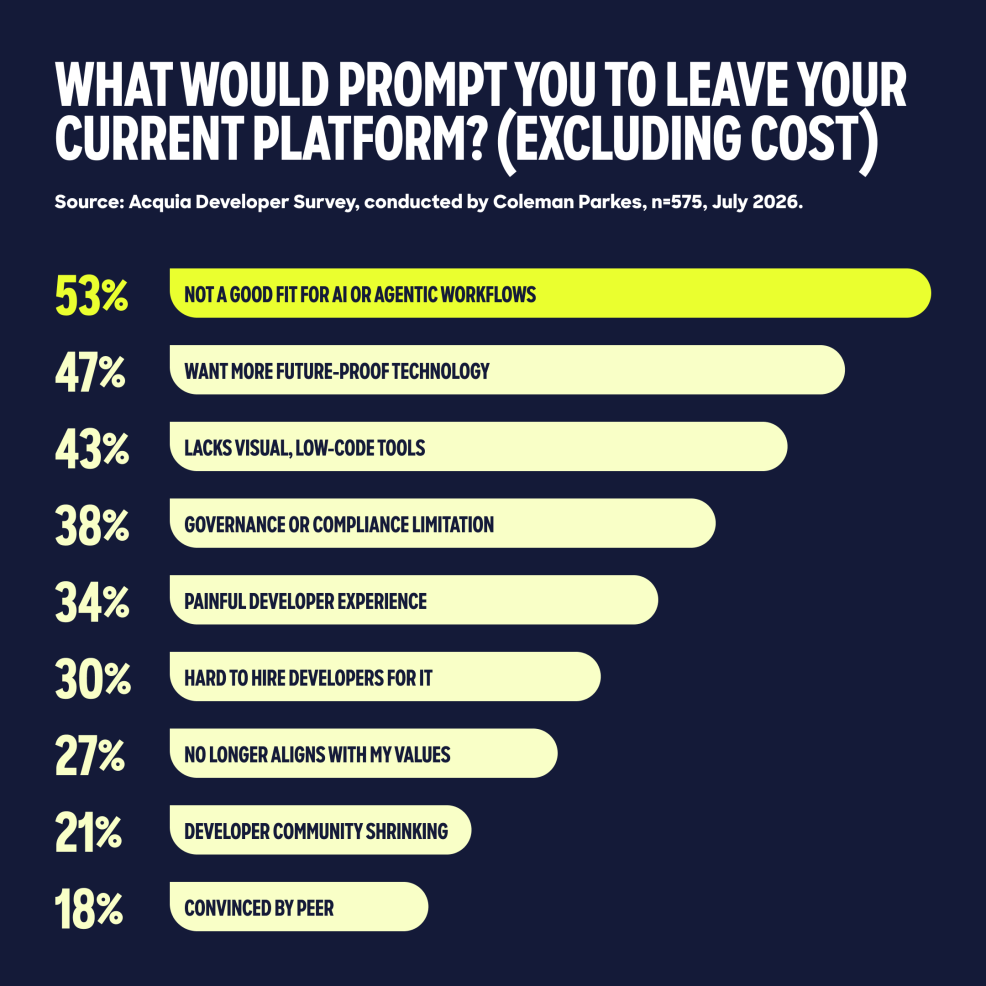
We found that 53% of developers said a platform that isn't a good fit for AI or agentic workflows would prompt them to move on. This is a really interesting data point: developers rank AI readiness third as a reason to choose a platform, but first as a reason to leave one.
Setting cost aside, here's what else would make developers leave:
- 47% would leave for a technology that feels more future-proof.
- 43% would leave a platform without the visual, low-code tools they need to prototype quickly.
- 38% would leave over a governance or compliance limitation the platform can't solve.
- 34% would leave if their experience is painful compared with modern alternatives.
The youngest developers are the quickest to look elsewhere. Among 18- to 24-year-olds, 60% would leave over missing low-code tooling, and 54% for more future-proof technology.
If you're weighing a new platform, check its AI fit now, before you've built on it and before you're facing another CMS migration.
What are developers prioritizing as AI agents change the web?
Our research shows that 58% of developers ranked integrating AI tools into their development workflow among their top three priorities.
From there, developers worry about the platform and the content underneath it:
- 53% want a platform that won't need a full rebuild as AI changes.
- 51% want their content structured so AI agents can reliably find, query, and act on it.
- 47% want to build experiences that work equally well for people and AI agents.
- 44% of developers prioritize controlling what AI agents can and can't do with their content.
The biggest split is over rebuild risk. 57% of developers working outside Drupal want a platform that won't need a full rebuild, compared with 47% of Drupal developers. Developers on other platforms are noticeably more worried about having to start over.
CIOs and CTOs are focused on the same foundation. 56% say they won't roll out AI features until their content structure and data integrity are solid, and 63% want to free up their teams by spending less time on maintenance.
Where do developers research a new CMS?
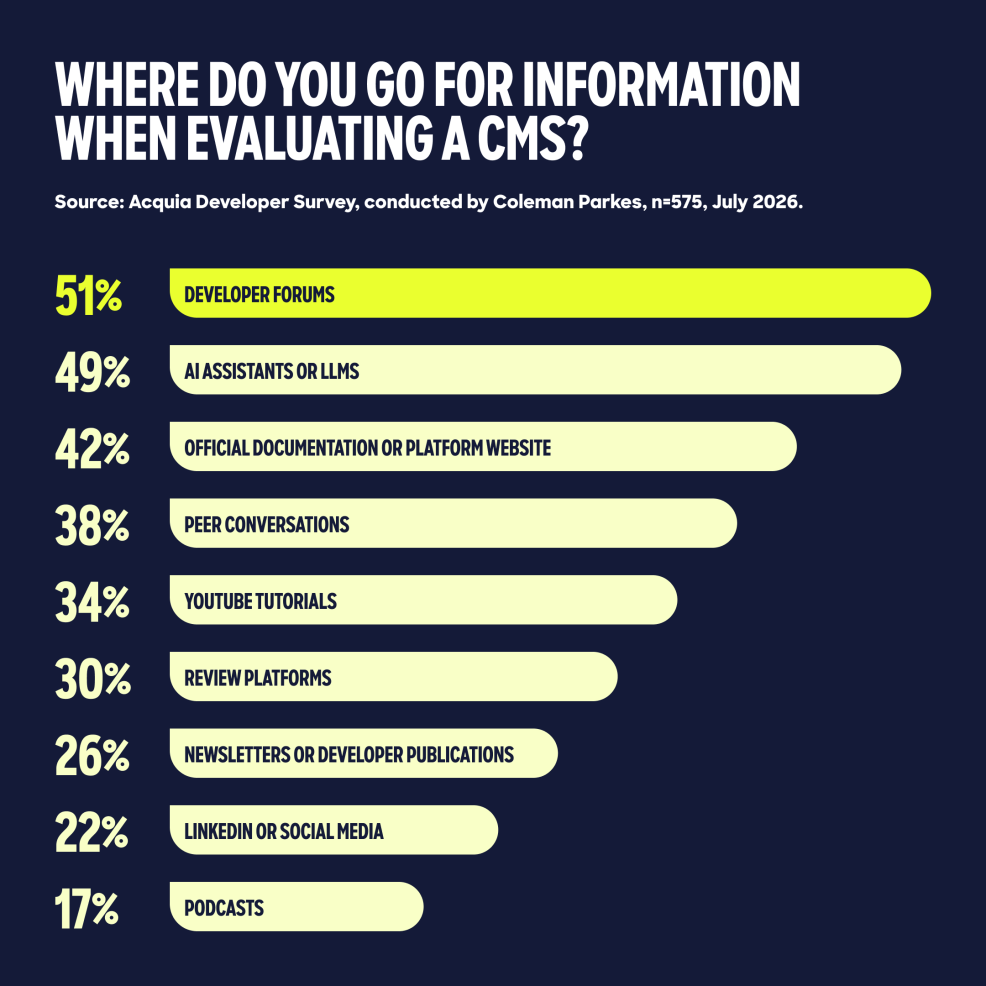
When researching a new CMS, developers turn to forums and AI assistants before vendor websites. 51% said they'd go to developer forums such as Reddit, Stack Overflow, and Discord, and 49% would ask an AI assistant such as ChatGPT, Claude, or Copilot. Official documentation and platform websites come third at 42%, followed by peer conversations (38%) and YouTube tutorials (34%).
Older developers research differently. Developers aged 55 to 64 lean on official documentation (59%) and review sites such as G2 and Capterra (55%), and they're far less likely to use forums (23%). That group is small (22 respondents), so treat the difference as directional.
If half of developers ask an AI assistant about a platform, the same is likely true of the visitors who use the sites you build. Content structure decides what the AI assistant can actually find and surface.
How to choose a CMS, according to 575 developers
Everything should start with security and performance. Once you have a shortlist of CMS providers, you should test them on three key questions. Can you support agentic workflows now, not just on a roadmap? Is your content structured well enough for an AI assistant to actually use it? Will you have to rebuild to keep up as AI changes, or does the architecture already account for that? A platform that fails any of those three won't last three years. You'll be migrating off it before then.
Methodology
Acquia commissioned research firm Coleman Parkes to run an online survey of 575 web developers from July 7 to July 29, 2026.
- Markets: United States (300 respondents), the United Kingdom (200), and France (75).
- Who they are: 241 work in-house, 183 at agencies, 114 as freelancers, and 37 are currently job seeking. They work across the public and private sectors.
- Platform background: 190 describe themselves as Drupal specialists. The other 385 primarily work in WordPress, other enterprise CMS platforms, headless platforms, or AI-native web builders.
- Question format: Questions about buying criteria and priorities asked respondents to rank their top three. Questions about evaluation triggers, reasons to leave, and research sources allowed multiple answers.
CIO and CTO survey: Coleman Parkes also ran an online survey of 250 CIOs and CTOs (125 of each) from July 10 to August 2, 2026, across the United States (125 respondents), the United Kingdom (63), and France (62). Respondents were split evenly across five sectors: public sector and government, higher education, financial services and insurance, NGOs, and manufacturing, retail, and SaaS.
How to cite this research: Acquia Developer Survey, conducted by Coleman Parkes, n=575 web developers in the US, UK, and France, July 2026. For CIO and CTO figures: Acquia CIO/CTO Survey, conducted by Coleman Parkes, n=250, July to August 2026.
Director, Analyst & Media Relations Marketing Acquia