Should We Adapt to AI, or Should AI Adapt to Us? Aidan's Foster's Perspective

Collection :
Should we adapt to AI, or should AI adapt to us? Aidan Foster put that question to the room at the Southwestern Ontario Drupal Camp. His answer: both, as long as people keep making the judgment calls.
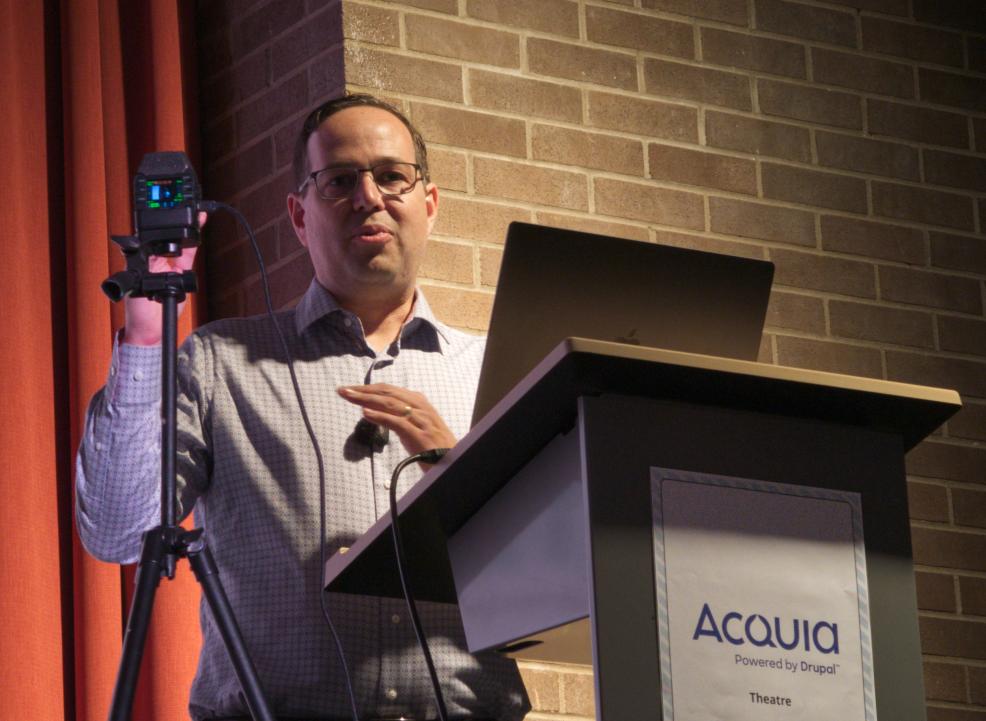
Aidan Foster is the founder of Foster Interactive, a member of the Drupal AI Initiative, and a familiar voice in the Drupal community. He opened his keynote, "The AI Survivor's Handbook," by asking the audience to turn on their skepticism. Every AI talk deserves it, he said, including this one.
What followed was one agency owner's account of three years of AI anxiety, along with the changes he is making inside his own team.
From existential crisis to cautious excitement
Aidan's first AI crisis came in March 2023. With an 80-page RFP response due in an hour, he realized he had left a new team member out of the proposal. He fed existing bios, a LinkedIn profile, and rough notes into ChatGPT. Minutes later, the proposal was 81 pages and ready to submit.
It worked. The worry came later. His own skills grew steadily year over year, while AI had jumped from writing novelty poems to doing real work in a matter of months. "When will it be better than me at something I am good at?" he asked.
He spent the next two years worried about his job and his team. Slowly, the worry turned into cautious optimism, then into excitement. That said, trying to keep up with AI’s constant evolutions can lead to total exhaustion, he admitted.
People buy light, not oil
It feels like nothing like this has ever happened before. Aidan argued that it has.
In 1800, London was a city of about one million people, lit by streetlamps fueled by whale oil. Fleets of ships sailed to Greenland, hunted whales, and hauled the blubber home to be boiled down. Thousands of people built barrels, shipped oil, and worked as lamplighters, lighting about 15,000 lamps up to three times a day.
That entire economy lasted roughly 80 to 90 years. Then, in the span of a decade or two, gas replaced it. Gas eventually gave way to electricity.
"Am I the whale oil salesman of my time?" Aidan asked.
The businesses that made it through those transitions were not the ones selling the highest-quality whale oil. They were the ones with deep relationships and a real understanding of their customers and institutions. Gas companies with strong public and private partnerships became the power companies of the next era.
Nobody actually wanted oil. They wanted light, and the safety and extra hours it gave them. Before streetlamps, getting home after dark in a London winter meant hiring someone to walk beside you with a torch. Digital teams face the same question now: what are clients paying for? It is usually not the code or the copy itself.
Separate the headlines from the evidence
The headlines are scary. In 2025, AI got the blame for tens of thousands of layoffs. Aidan asked the room to check the research before believing them.
A study of thousands of companies across seven countries found executives reporting essentially no net effect of AI on employment. Statistics Canada data showed the country's most AI-exposed jobs growing at the same pace as other jobs. A growing number of commentators argue that some companies are cutting staff because of AI's potential, not its current performance.
Some jobs are taking real hits, and Aidan did not play that down:
- Writers and translators have seen freelance demand fall by 20%–50% since ChatGPT launched.
- Coding and writing roles have seen about a 21% drop in postings for tasks that are easier to automate.
- Customer service teams are shrinking, with about 20% of support leaders reporting AI-driven downsizing.
Then there is the feeling of waking up every morning already behind. Aidan works with some of the most dedicated AI experts in the Drupal AI Initiative, and they feel it too. In his view, the urgency is manufactured, mostly by marketing built to win attention and investment. Unless you hold a lot of stock in an AI company, who wins that race makes little difference to you.
The change in the industry is real. But if you need to tune out for a few weeks or months for your own mental health, Aidan promised you will not fall hopelessly behind. He has started paying less attention to marketing and more to researchers, safety experts, and whistleblowers.
Execution is getting cheap. Judgment is not.
AI is excellent at patterns: writing code, generating words, and executing well-defined tasks. People are good at different things:
- Creativity to imagine new ideas that stand out.
- Strategic thinking to understand an audience, sequence the steps, and predict the impact of decisions.
- Experience to judge which ideas will actually land.
As execution becomes faster and cheaper, deciding which ideas deserve to be executed becomes more valuable than ever. "AI will always answer whatever question you give it very convincingly," Aidan said, "but it never helps you consider whether the question you asked in the first place was a good question at all." He made the point with a deliberately absurd example: tell ChatGPT you took a $100,000 cash advance to launch a swimming-lessons-for-cats business, and it will cheerfully offer to write your marketing plan.
Creativity is not only for designers, either. It applies to code, science, economics, and strategy, not only visual design. Whatever ways you contribute to your team’s success, the ability to envision new approaches will take your work to another level, especially when you can also adjust them based on the audience and the context, and think critically about the likelihood of success for each idea based on your own experience.
Research on creative breakthroughs shows two peaks: one in the mid-20s for conceptual innovators and another in the mid-50s for experimental innovators who build on accumulated experience. What’s more, creativity is something we can work to develop. In one study, business students who completed 140 hours of creativity training generated 86% more ideas than before. A control group with the same year of school but no training barely improved.
Yes, we should adapt to AI — thoughtfully
We are already adapting, whether we mean to or not. Researchers have tracked a sharp rise in words like "delve" and "meticulous" in everyday and academic speech since ChatGPT arrived. We are starting to talk like the tools we use.
Other changes are more worrying. In one study, participants who used ChatGPT to write an essay struggled to recall their own work: 83% could not quote a single line, compared to 11% of those who wrote with a search engine or on their own. The risk, Aidan said, is handing our thinking to AI and no longer understanding the work we put our names on. Though he didn’t use the same words, the point Aidan made here aligned with the middle path for AI adoption I have sometimes described as becoming a “code director”.
A mockup is not production
Aidan shared a story familiar to many agencies. A B2B CEO spent a weekend using AI to build a new homepage, then asked the agency to launch it by Wednesday. To the CEO, it looked finished. To the agency, it was missing integrations, accessibility, performance work, the design system, and a path into the CMS.
The agency owner who told Aidan this story was frustrated. Aidan sees growing pains. The CEO did not have the skills to sketch ideas in a design tool, and now had a way to communicate a vision visually. That artifact becomes a starting point for subject matter experts to turn into something deployable. "We are helping people learn to communicate and collaborate in a new language," he said. There are growing pains as people realize that these AI tools can be powerful to help breathe life into a vision, but that the result often still needs significant work before it’s ready for public consumption.
Question the workflows you take for granted
Experience can also get in the way. When a process has been refined over 20 years, it is hard to notice that the problem it was built to solve has changed. The two-week Agile sprint assumes tasks take days and must be split among specialists. What if a task now takes hours?
Aidan floated a "micro sprint" model: experts collaborate on a detailed specification, AI produces the work overnight, and the team reviews it the next morning. Because output is cheap, the team keeps what works, discards what does not, updates the spec, and runs it again. He also pointed to an article that went the other way, with the headline "Agile is dead. AI killed it. Welcome back, waterfall." He was not recommending either one. His point was that we need to continue to rethink how we collaborate and structure our work across teams, to suit our changing tools and skillsets.
Break down silos
Aidan is also encouraging developers to join design conversations and designers to join development conversations. Today, when a developer finds a missing design component, a ticket goes to a busy designer and comes back days later. In a standard sprint, that can be a significant setback. Instead, the developer can generate a few rough options with AI, then hop on a quick call with the designer. The designer keeps control of the decision, the developer builds new skills, and a three-day delay can shrink to three hours.
And yes, AI must adapt to us
"Without context, AI is literally the average of the internet," Aidan said. Ask it for a landing page, and you get a blend of every landing page it has ever seen. Plenty of people stop at that point. You can see the results all over LinkedIn: posts that look roughly right and say nothing.
Fixing that is hard work. Aidan urged organizations to sit down with cross-disciplinary teams, ideally in person, and define who they are:
- Values
- Tone and voice
- Conventions
- Key facts about the organization
- Audiences
- Value propositions for each audience
Record the conversation, document the results, and turn them into source material, such as skill files or Markdown files that your AI tools can use. That context makes AI output reflect your organization instead of the internet's average.
With that in place, a good AI content system does speed things up. Aidan warned against stopping there. Speed is the means, not the end. Its real value is the chance to iterate many times, improving quality and trustworthiness with each pass. "When everyone else is shipping fast," he said, "quality is what allows us to stand out."
A practical playbook for teams
Everyone is reinventing their role right now. Aidan has seen UX teams renamed product designers and large financial institutions creating titles like conversational experience designer. Changing job titles is fast, but operationalizing the changed intent for those roles takes much longer. Here is what has worked for his own team:
- Make time to practice. Set aside a regular block, such as Friday afternoons, for nonbillable experiments with AI tools. Give each experiment a clear goal, a start, and a finish.
- Share results, especially failures. Failed experiments often spark the best conversations and seed the next idea.
- Listen to newer voices. A wealth of experience can hide ingrained assumptions. Newer team members often see what veterans miss.
- Get better at asking. Invest in prompt training and follow tutorials to see how others work with AI tools.
- Compare approaches. Ask two people, such as a project manager and a developer, to solve the same problem independently, then compare how they did it.
Aidan's agency has reframed its own identity along the way. It used to describe itself as a web design company that did a lot of strategy work. Now it is a strategy company that does a lot of web design work.
We are not in a race
Aidan admitted that changing how his agency works is hard and a little scary. He ended on this: "We are not in a race with each other. We are all building this plane as we fly it." From large bank design teams to solo freelancers, everyone is figuring it out at the same time.
That is why community matters. Aidan encouraged attendees to join local Drupal groups, get involved in the Drupal AI Initiative, find peer groups in their discipline, and find a mentor or become one. He credits a digital agency owners group that meets every two weeks with teaching him more about adapting to AI than any headline ever has.
We agree. Drupal has always worked this way, with people from competing agencies and companies sharing what they learn so everyone gets better. This has always been the very heart of open source. That doesn’t change with AI. In fact, what we’re already seeing is that AI increases the rate of changes across markets. By not only sharing code but also sharing ideas and approaches to succeed in these changing landscapes, we can ensure shared success into the future.