
25 Years of Drupal. One Accidental Advantage.
In 2001, a student in Belgium named Dries Buytaert built a message board for his friends and released it as open source. He has called the decision partly accidental. From where Acquia sits today, it looks like the most important architectural choice in the company's history.
In this Engage London 2026 keynote, Scott Falconer, who serves on the Drupal AI leadership team, traces the 25-year arc from that decision to where Drupal stands now: uniquely ready for the agentic era.
The talk covers the evolution. How an open source project became the foundation for some of the world's most demanding digital experiences. How the community, developers, site builders, agencies, governments, universities, and global brands pushed Drupal toward structure: content models, permissions, workflows, APIs, governance, multilingual content, integrations. How Acquia was created to help enterprises run those experiences at scale. And how the same community, more recently, chose to disrupt itself with Drupal CMS, Drupal Canvas, and Drupal AI, making that power easier to reach.
Then Scott names the shift. AI is not just another feature, it is changing the economics of everything. But Drupal has what he calls the accidental advantage. Two decades of enterprise pressure already pushed Drupal toward exactly what AI agents need to work reliably: structured content instead of guesswork, permissions instead of unlimited access, workflows instead of chaos, APIs instead of free-for-all.
Generation has been commoditized. Governance is the differentiator. Drupal already has it.


Related Videos
-
Image
 Changing the Way: The Opening KeynoteEvent Highlights
 -
Image
 England Rugby's Digital TransformationEvent Highlights
 -
Image
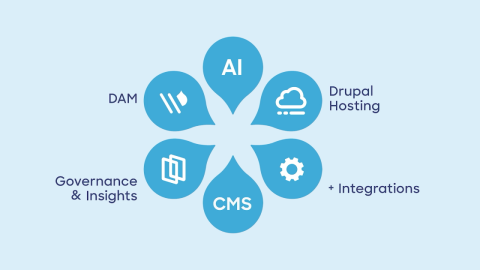 Inside Acquia Source Command CenterEvent Highlights
 -
Image
 Save the Children’s Global CMS StoryEvent Highlights
 -
Image
 Launching a Publication in Minutes with Acquia AIEvent Highlights
 -
Image
 Enterprise Grade. Now at the Speed of AI.Event Highlights
 -
Image
 Enterprise Grade at AI SpeedEvent Highlights
 -
Image
 Generative Engine OptimizationEvent Highlights